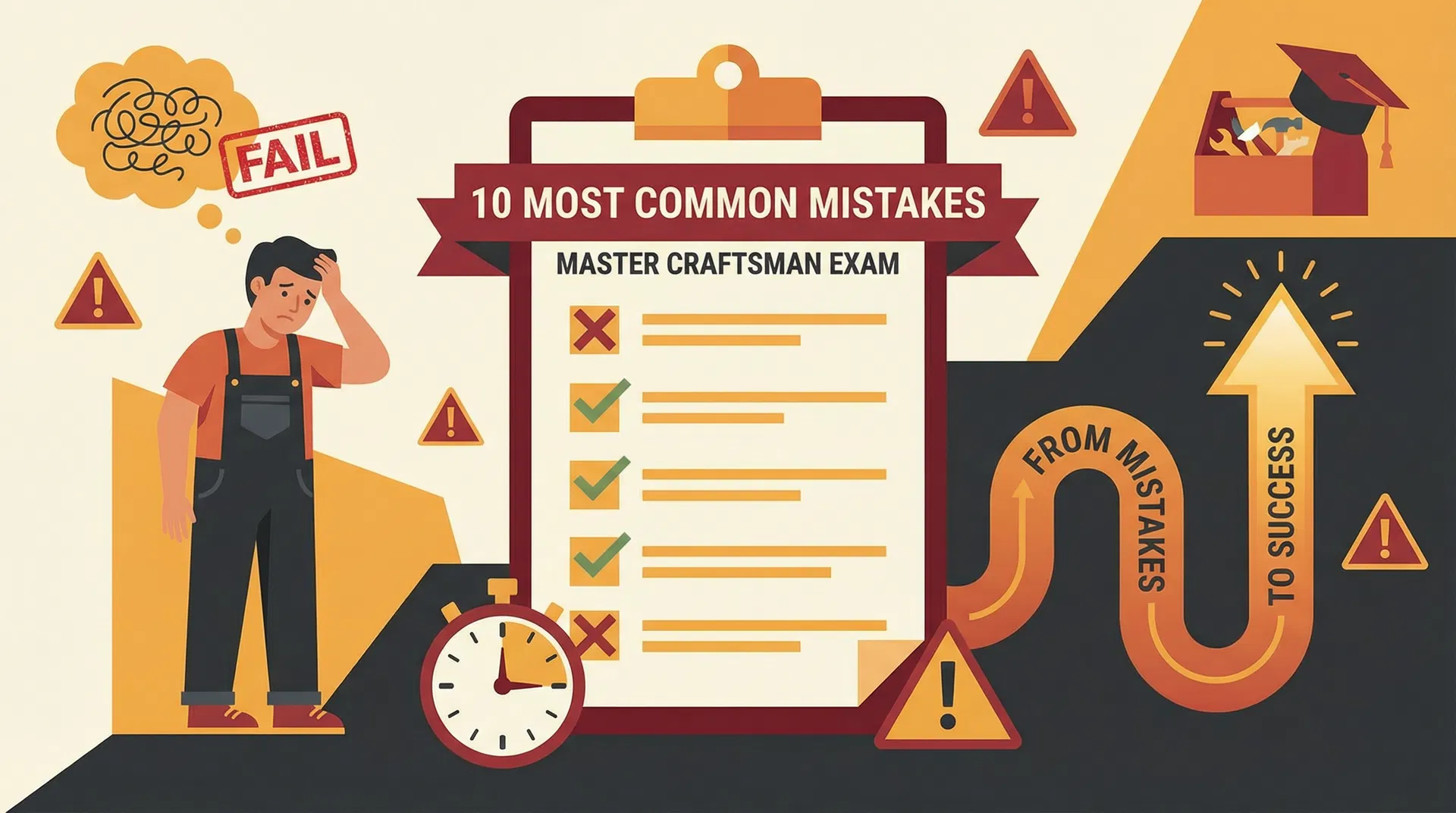
The 10 Most Common Mistakes in the Master Craftsman Exam and How to Avoid Them
The master craftsman exam – a milestone in your professional career that opens doors to new responsibilities and opportunities. The path to it is demanding and requires a lot from you. You are probably in the middle of preparations, poring over books, attending courses, and investing a lot of time and energy. The pressure is high, as you want to master this important step with flying colors. But precisely in this intensive phase, there are some pitfalls that have already led to the downfall of many candidates. But don't worry, you don't have to make the same mistakes! In this article, we have summarized the ten most common mistakes in the master craftsman exam for you and show you how to skillfully navigate them. Learn from the experiences of others and go into your exam optimally prepared.
Mistake 1: Inadequate Time Management and Organization
One of the biggest and also most common mistakes is underestimating the learning effort and the associated inadequate time management. Many aspiring master craftsmen start highly motivated, but without a clear structure, the initial euphoria quickly fades. The sheer amount of learning material can be overwhelming, and without a plan, one often doesn't even know where to start. The result is often procrastination – postponing unpleasant tasks – and in the end, one gets caught in a vicious circle of stress and panic.
The Solution: Your Personal Battle Plan
The key to success lies in realistic and well-structured time management. Create a detailed study plan that covers all exam-relevant topics. Break down the material into small, manageable learning units and determine when you want to work on which topic. It is important that your plan is realistic and also includes buffer times for unforeseen events or more difficult subject areas. Use digital tools such as calendar apps or project management software to visualize your learning progress and motivate yourself. A well-thought-out plan not only gives you security but also helps you to stay on track continuously.
Example of a simple weekly study plan:
| Weekday | Morning (2h) | Afternoon (2h) | Evening (1h) |
|---|---|---|---|
| Monday | Topic A: Basics | Topic B: Deepening | Review Topic A |
| Tuesday | Topic C: New Chapter | Practice exercises Topic B | Review Topic C |
| Wednesday | Study group: Discussion | Topic D: Practical relevance | Free |
| Thursday | Topic E: Review old material | Practice exercises Topic D | Weekly summary |
| Friday | Exam simulation | Simulation evaluation | Free |
| Saturday | Free | Free | Free |
| Sunday | Weekly planning | Light reading | Relaxation |
Mistake 2: Wrong Learning Strategy
Many candidates tend to only passively consume the learning material. They read their documents over and over again and hope that the knowledge will somehow stick. But this is a fallacy. Passive learning is inefficient and rarely leads to a deep understanding of the subject matter. Those who only read hardly activate their brains and quickly forget what they have learned.
The Solution: Become an Active Learner
To truly master the learning material, you need to actively work with it. Instead of just reading, you should apply various learning techniques that challenge your brain. Summarize the most important content in your own words, create mind maps to visualize connections, or use the proven method of flashcards. A particularly effective technique is "teaching." Try to explain a complex topic as simply as possible to a friend or family member. If you are able to convey the knowledge understandably, you have truly understood it. The combination of different learning methods not only provides variety but also sustainably anchors the knowledge in your memory.
Mistake 3: Insufficient Knowledge of the Examination Regulations
The examination regulations are the "basic law" of your master craftsman exam. They contain all important information about the procedure, content, evaluation criteria, and permitted aids. Surprisingly, many candidates do not take the time to carefully study this important document. This can have fatal consequences, for example, if one is confronted with an unexpected task format in the exam or does not have important aids with them.
The Solution: Make the Examination Regulations Your Friend
Take enough time to read the examination regulations of your IHK or Chamber of Crafts applicable to you from beginning to end. Mark the most important passages and clarify open questions in good time with the responsible examination board. If you know exactly what to expect, you can prepare yourself specifically and avoid unpleasant surprises on the day of the exam. This not only gives you security but also a decisive advantage over less well-informed competitors.
Mistake 4: Neglecting the Practical Exam Parts
The master craftsman exam usually consists of a theoretical and a practical part. Many candidates focus almost exclusively on theory during preparation and neglect practical skills. They assume that their professional experience will be sufficient. However, the practical exam has its own pitfalls and often requires a specific approach that is not always demanded in everyday professional life.
The Solution: Practice Makes Perfect
Even if you are an absolute professional in your job, you should not take the practical exam parts lightly. Practice the required work samples and projects under exam-like conditions. Ask experienced colleagues or your instructor to look over your shoulder and give you honest feedback. The more often you train the practical tasks, the more confident and routine you will become. This way, you can perform at your best on the day of the exam and convince the examiners of your skills.
Mistake 5: Starting Exam Preparation Too Late
"I still have time" – this thought has already put many candidates in a difficult situation. The time until the exam often passes faster than you think, and those who start learning too late inevitably come under enormous pressure. The so-called "bulimia learning," in which one tries to cram all the material shortly before the exam, is not only extremely stressful but also not very sustainable. Most of the knowledge is immediately forgotten after the exam.
The Solution: The Early Bird Catches the Worm
Start exam preparation as early as possible. A continuous learning process over a longer period is far more effective and stress-free than short-term acts of force. Your brain needs time to process new information and store it in long-term memory. An early start allows you to calmly work through the material, identify knowledge gaps, and close them specifically. This way, you build a solid knowledge foundation that will carry you safely through the exam.
Mistake 6: Exam Anxiety and Stress
A certain degree of nervousness before such an important exam is completely normal and can even enhance performance. However, if anxiety gets out of hand and leads to mental blocks or a blackout, it becomes a serious problem. Exam anxiety can undo all the hard work of preparation.
The Solution: Keep a Cool Head
The best way to get a grip on exam anxiety is good preparation. The more confident you feel in the material, the calmer you will go into the exam. In addition, targeted relaxation techniques such as autogenic training, progressive muscle relaxation, or breathing exercises can help reduce nervousness. A positive attitude is also crucial. Keep telling yourself that you can do it and that you are well prepared. Simulate the exam situation at home to get used to the pressure. The more often you expose yourself to the situation, the less frightening it becomes.
Mistake 7: Formal Errors and Carelessness
In the rush of the exam, careless mistakes quickly creep in. Tasks are not read correctly, the handwriting is barely legible, or formal requirements are disregarded. Such mistakes are particularly annoying because they would be easily avoidable and unnecessarily cost points.
The Solution: Diligence and Concentration Until the End
At the beginning of the exam, take a moment to read all tasks calmly and completely. Mark important keywords and pay close attention to the question. Write legibly and structure your answers clearly. Be sure to plan some time for a final check at the end of the exam. Go through your answers again and check them for formal errors and carelessness. A few minutes for checking can make the difference between passing and failing.
Mistake 8: Lack of Breaks and Rest
Those who study around the clock are not doing themselves any favors. The brain needs regular breaks to process what it has learned and to recharge its energy. Those who neglect rest risk burnout and a decrease in learning efficiency. At some point, the point is reached where you simply cannot absorb anything more.
The Solution: Treat Yourself to a Break
Plan fixed breaks and leisure activities into your study schedule. Regularly take a break from your desk and do something you enjoy and that relaxes you. Whether it's sports, meeting friends, or just a cozy evening on the couch – rest is just as important as studying itself. A rested mind is more receptive and creative. Also, ensure you get enough sleep and eat a healthy diet to optimally support your body and mind.
Mistake 9: Lone Wolf Mentality Instead of Study Groups
Many candidates prepare for the master craftsman exam alone in their quiet room. They shy away from exchanging ideas with others because they fear revealing knowledge gaps or feeling pressured by others. In doing so, they miss out on the valuable benefits of collaborative learning.
The Solution: Together We Are Strong
Find a study group with motivated fellow students. Exchanging ideas with others helps you to look at complex topics from different perspectives and deepen your own understanding. You can motivate each other, identify knowledge gaps, and support each other with difficult topics. Jointly solving practice exercises and discussing exam content are invaluable aids in preparation. A good study group is more than just a community of convenience – it can become a real support on the way to the master craftsman title.
Mistake 10: Giving Up After Setbacks
Preparing for the master craftsman exam is a marathon, not a sprint. There will always be phases where
Tags:
Read more
Other articles that might interest you
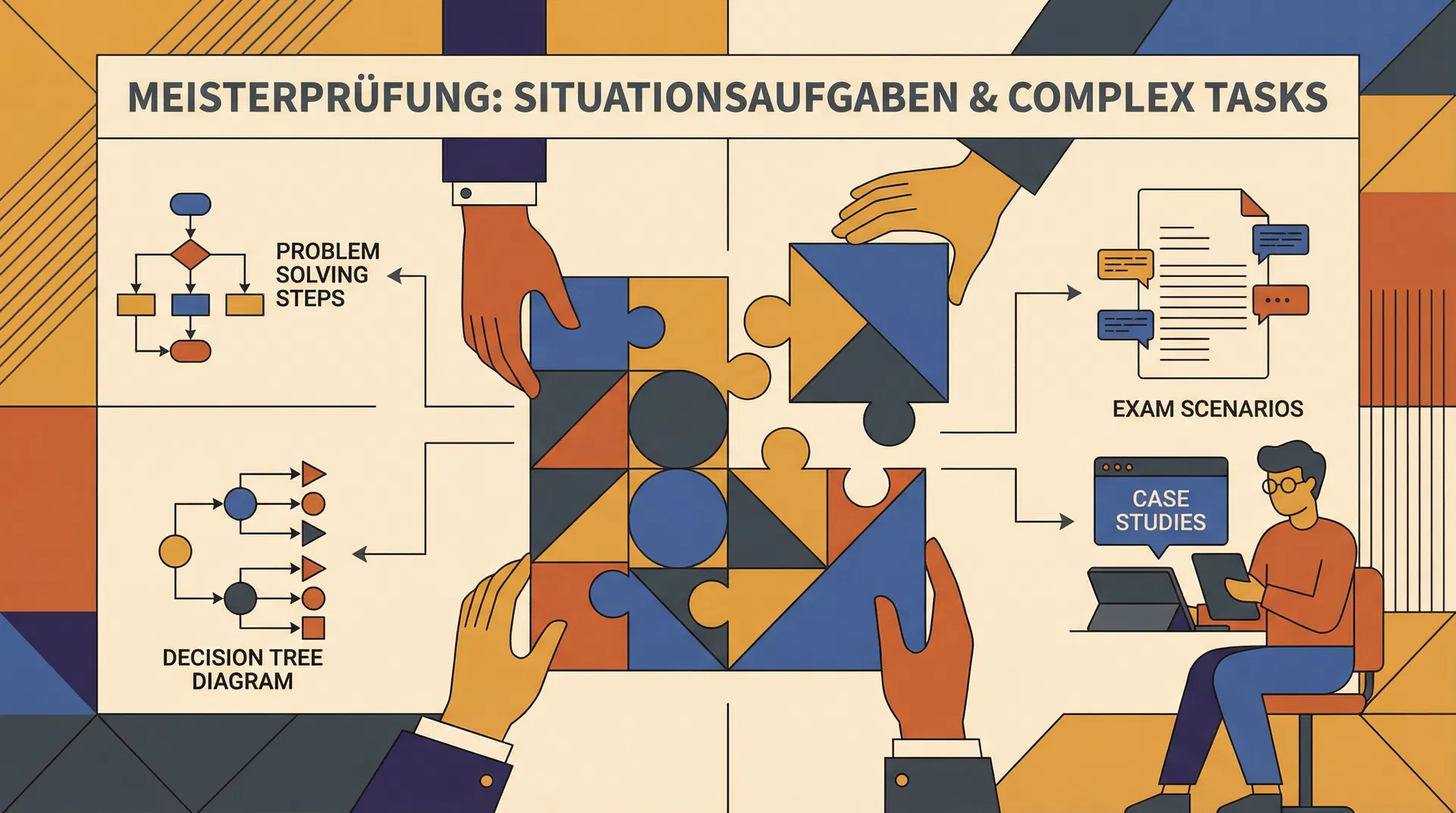
Situationsaufgaben in der Meisterprüfung: Strategien für die komplexe Prüfungsform
Die Situationsaufgaben in der Meisterprüfung sind eine grosse Hürde. Mit der richtigen Strategie und Vorbereitung meisterst Du aber auch diese komplexe Prüfungsform. Wir zeigen Dir, wie es geht!
Read more
Industriemeister-Prüfung 2025: Die 10 besten Tipps zur Vorbereitung
Du willst die Industriemeister-Prüfung beim ersten Anlauf bestehen? Hier sind die 10 bewährtesten Strategien, die erfolgreiche Absolventen nutzen – von der Lernplanung bis zur Prüfungssimulation.
Read more
IHK-Prüfungskriterien für Industriemeister: Was Prüfer wirklich sehen wollen
Erfahre, worauf IHK-Prüfer bei der Industriemeisterprüfung wirklich Wert legen. Einblicke in Bewertungsschema, Punkteverteilung und Tipps von echten Prüfern.
Read more