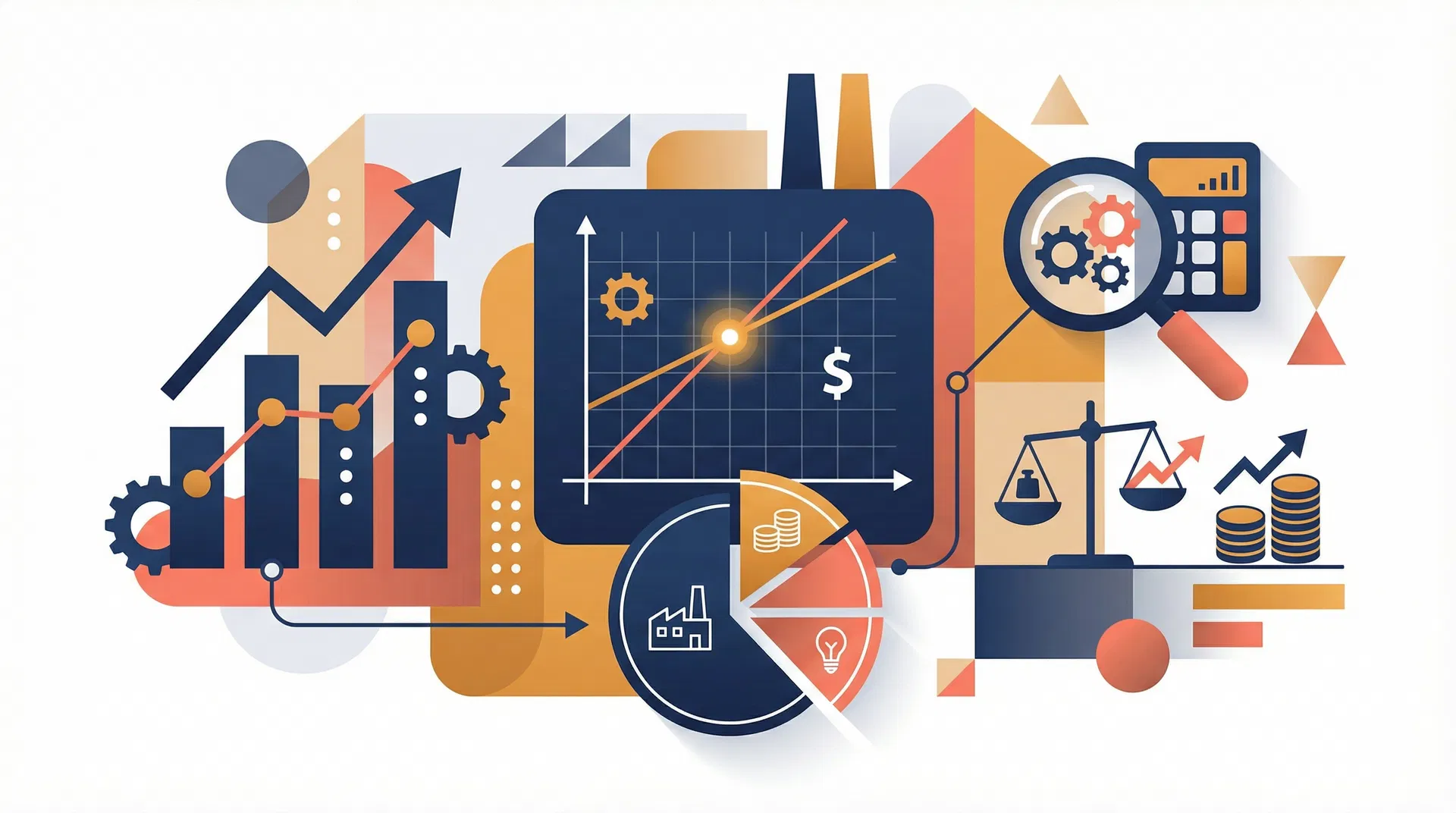
Business management is one of the core qualifications for aspiring industrial foremen and a cornerstone for the success of any company. But what exactly does this term mean? At its core, it's about designing operational processes to be economical, efficient, and goal-oriented. In this article, we delve deep into three crucial areas that every foreman must master: cost and performance accounting (CPA), investment appraisal, and budgeting. These instruments are not dry theory but rather the tools to make informed decisions that keep your company on track and steer it toward a profitable future.
CPA as the Company's Navigation System
Imagine you are steering a ship on the open sea. Without a compass, chart, and GPS, you would be lost. Cost and performance accounting (CPA) is precisely this navigation system for your company. It provides the necessary information to know where you stand, where you are heading, and whether you are on the right course. CPA is the heart of internal accounting and essentially pursues four main goals:
- Planning and controlling profitability: CPA helps you plan, monitor, and analyze cost deviations. This allows you to take corrective action early if something goes awry.
- Informed decision-making: Whether it's about accepting an additional order, setting price floors, or deciding between in-house production and external procurement – CPA provides the crucial data.
- Determining the operating result: Unlike financial accounting, which determines the company's overall result, CPA focuses on the actual operating result, adjusted for neutral expenses and revenues.
- Valuation of goods and services: CPA is the basis for calculating manufacturing costs and thus for pricing your products and services.
The Three Stages of CPA: A Logical Structure
CPA is not a monolithic block but is divided into three logically structured stages. Each stage answers a central question and provides the basis for the next. This three-stage structure ensures transparency and systematic recording of all relevant data.
Cost Type Accounting: What Costs Are Incurred?
The first stage, cost type accounting, is the foundation of the entire CPA. It answers the question: What costs were incurred in a given accounting period? To do this, costs are systematically recorded and classified. A common distinction relevant for the foreman examination is based on the origin of the production factors:
| Cost Category | Examples | Description |
|---|---|---|
| Personnel costs | Wages, salaries, social security contributions | Costs for human labor. |
| Material costs | Raw materials, auxiliary materials, operating materials | Costs for goods consumed in the production process. |
| Capital costs | Interest on loans, imputed interest | Costs for the use of capital. |
| Service costs | Rent, leasing, consulting and transport costs | Costs for services rendered by third parties. |
| Depreciation | Straight-line or declining balance depreciation on machinery | Decrease in value of fixed assets. |
Another important distinction in cost type accounting is based on the traceability of costs. Direct costs can be directly assigned to a cost object (e.g., a product), such as the wood for a specific table. Indirect costs, on the other hand, are incurred jointly for several cost objects and must be allocated using allocation keys, such as the rent for the production hall.
Cost Center Accounting: Where Are the Costs Incurred?
After knowing what costs were incurred, the second stage, cost center accounting, answers the question: Where in the company did these costs arise? For this purpose, the company is divided into so-called cost centers. A cost center is a place where costs originate and services are charged, for example, a department (production, administration, sales) or a machine.
The central instrument of cost center accounting is the operating cost sheet (BAB). In the BAB, the indirect costs recorded in cost type accounting are allocated to the individual cost centers using allocation keys. This makes it transparent which department causes which costs. Direct costs are not considered here, as they can be directly assigned to the cost object.
Example of a simplified operating cost sheet:
| Indirect Cost Type | Total Costs | Allocation Key | Material | Production | Administration | Sales |
|---|---|---|---|---|---|---|
| Rent | €10,000 | Area in m² | €1,000 | €6,000 | €2,000 | €1,000 |
| Salaries (indirect) | €20,000 | Number of employees | €2,000 | €10,000 | €5,000 | €3,000 |
| Electricity costs | €5,000 | Connected load (kW) | €500 | €3,500 | €500 | €500 |
| Total Indirect Costs | €35,000 | €3,500 | €19,500 | €7,500 | €4,500 |
At the end of the BAB, the indirect costs of the individual cost centers are added up, and so-called indirect cost rates are formed. These percentage rates are needed in the next stage to allocate indirect costs to products.
Cost Unit Accounting: For What Are the Costs Incurred?
The third and final stage, cost unit accounting, answers the crucial question: For what were the costs incurred? Here, all costs – direct costs and indirect costs determined via the allocation rates – are assigned to the individual cost units, i.e., the products or services. The result is the cost of goods sold calculation, which forms the basis for pricing.
A central instrument that builds on the data from cost unit accounting is the break-even analysis.
The Break-Even Point: When Your Company Starts Making a Profit
The break-even point is the point at which revenues exactly cover total costs. The company therefore makes neither a profit nor a loss. Every additional item sold beyond this point contributes directly to profit. Knowledge of the break-even point is essential for every foreman to understand the effects of price and cost changes and to plan production profitably.
The formula for calculating the break-even quantity is simple:
Break-Even Quantity = Fixed Costs / (Selling Price per Unit - Variable Costs per Unit)
The denominator (selling price - variable costs) is also called the contribution margin per unit. It indicates how much each product sold contributes to covering fixed costs.
Practical Example:
A company manufactures wooden chairs. Monthly fixed costs (rent, salaries, etc.) are €20,000. Variable costs per chair (material, manufacturing wages) are €50. The selling price per chair is €150.
- Contribution margin per chair: €150 - €50 = €100
- Break-even quantity: €20,000 / €100 = 200 units
The company therefore has to sell 200 chairs per month to cover all costs. The profit zone begins with the 201st chair.
Static Investment Appraisal: Making Quick Decisions
In addition to ongoing operations, companies must regularly invest in the future, be it in new machinery, vehicles, or technologies. Investment appraisal is the set of tools used to evaluate the economic viability of such investments and to compare different alternatives. Static methods are particularly popular because they are relatively easy to calculate and provide quick, initial indications. They always consider only a single period.
Cost Comparison Method: Finding the Cheapest Alternative
The cost comparison method is the simplest procedure. It compares the average costs of different investment alternatives per period. The alternative with the lowest costs is considered the most advantageous.
Example: A company is considering purchasing one of two new machines (A or B).
| Cost Type | Machine A | Machine B |
|---|---|---|
| Annual Depreciation | €10,000 | €8,000 |
| Annual Operating Costs | €5,000 | €7,500 |
| Total Costs per Year | €15,000 | €15,500 |
Result: According to the cost comparison method, Machine A would be the better choice as it incurs lower annual total costs.
Profit Comparison Method: Keeping an Eye on Maximum Profit
The profit comparison method extends the cost comparison method to include the revenue side. It compares the expected profit (revenues - costs) of the different alternatives. The alternative with the highest profit is preferred.
Example: We extend the previous example with the expected annual revenues.
| Position | Machine A | Machine B |
|---|---|---|
| Annual Revenues | €40,000 | €42,000 |
| Annual Total Costs | €15,000 | €15,500 |
| Profit per Year | €25,000 | €26,500 |
Result: Although Machine B has higher costs, it also generates higher revenues, leading to a higher profit. According to the profit comparison method, Machine B is the better investment.
Return on Investment (ROI) Method: How Profitable is the Capital Employed?
The return
Tags:
Read more
Other articles that might interest you

Arbeitsrecht für Industriemeister: Die 20 wichtigsten Paragraphen
Als Industriemeister sind Sie Führungskraft und Arbeitnehmer zugleich. Unser Artikel erklärt die 20 wichtigsten Paragraphen aus KSchG, ArbZG, MuSchG & BetrVG, die Sie für einen rechtssicheren Arbeitsalltag kennen müssen.
Read more
Umweltschutz und Arbeitssicherheit: Deine Pflichtthemen für die BQ-Prüfung 2025
Umweltschutz und Arbeitssicherheit sind zentrale Themen der BQ-Prüfung 2025. Erfahre hier alles Wichtige zu Arbeitsschutzgesetz, Gefährdungsbeurteilung und betrieblichem Umweltschutz.
Read more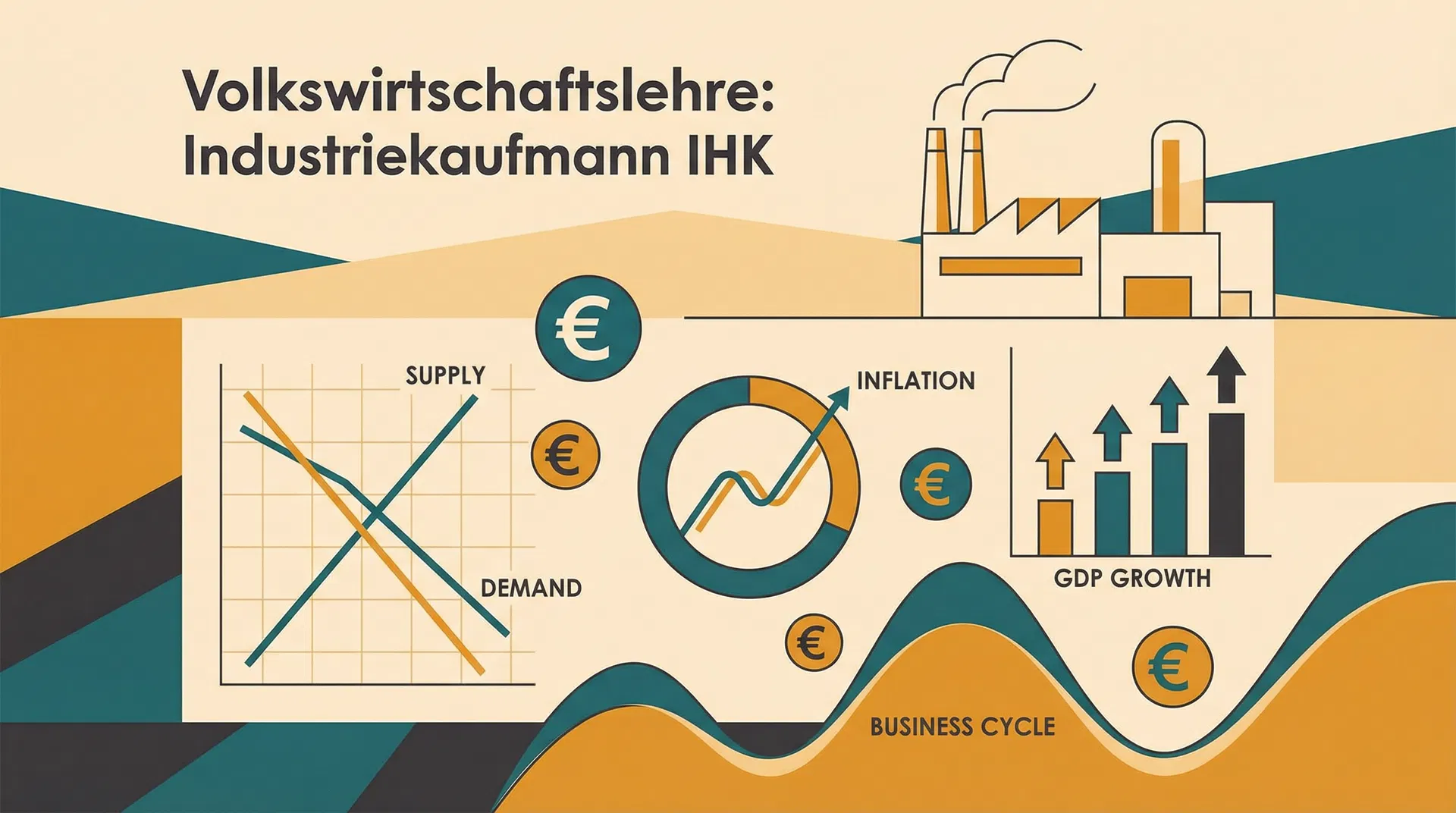
Volkswirtschaftslehre für Industriemeister: Konjunktur, Inflation & Wirtschaftspolitik einfach erklärt
Entschlüssle die Geheimnisse von Konjunktur, Inflation und Wirtschaftspolitik. Erfahre, warum VWL für Industriemeister entscheidend ist und wie du dieses Wissen für deine Karriere nutzt.
Read more