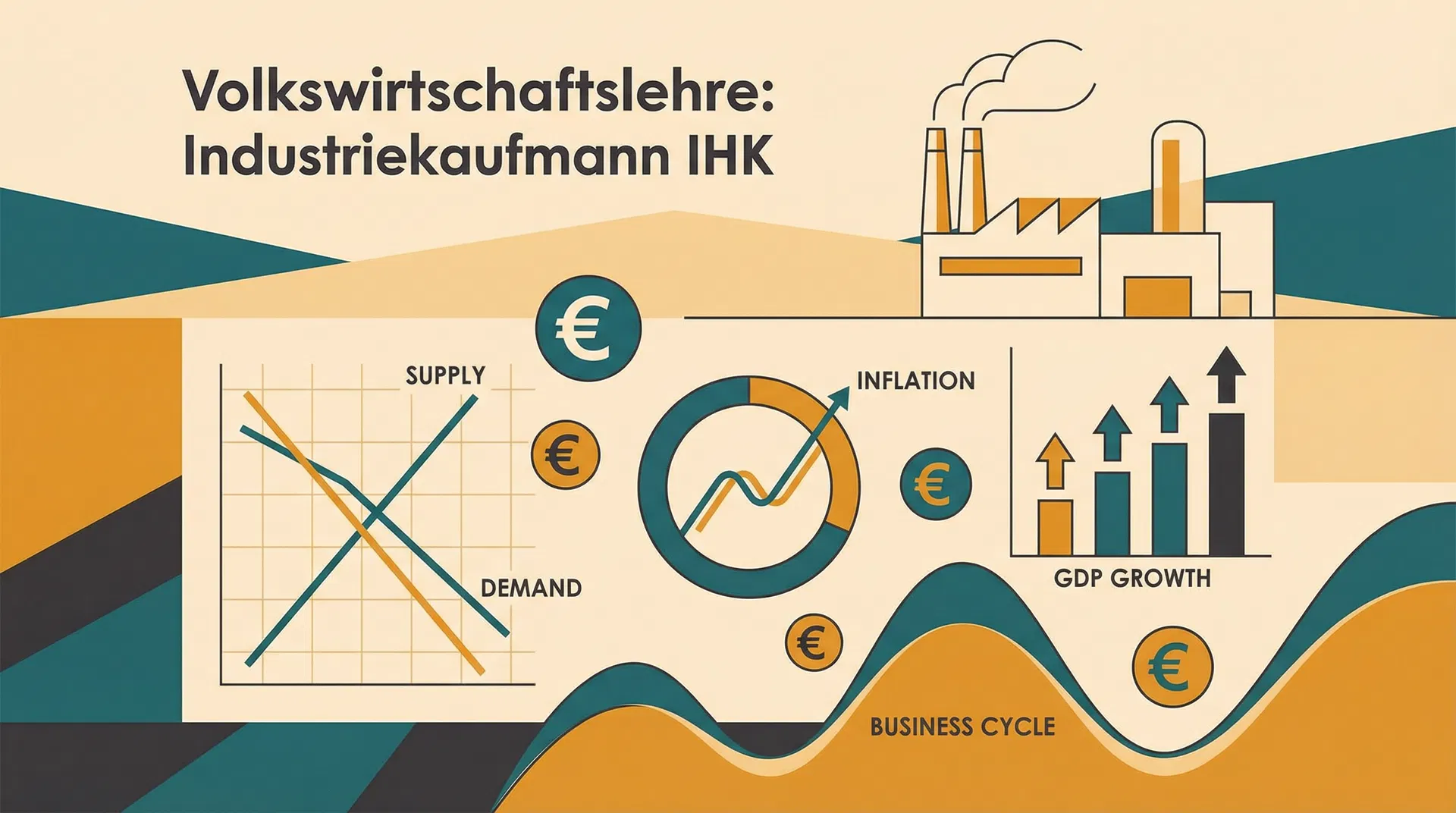
Economics for Industrial Foremen: Business Cycles, Inflation & Economic Policy Simply Explained
Imagine you could not only understand the news about the economic situation but also use the connections for your company and your career. As a prospective industrial foreman, this is not a distant dream, but a crucial competence. Economics (VWL) is far more than just dry theory – it is the operating system of our economy and a central component of your BQ examination. In this article, we will jointly decipher the secrets of business cycles, inflation, and economic policy. You will see: with the right understanding, economics becomes a powerful tool in your professional life.
The Heart of the Economy: The Business Cycle
The economy is like a living organism that does not always beat at the same rhythm. Sometimes it runs at full throttle, then again it takes a breather. These fluctuations in overall economic activity are what we call the business cycle. But why is this so? Quite simply: the ups and downs of supply and demand, technical innovations, but also political decisions and global events ensure constant movement.
The Four Phases of the Business Cycle
The business cycle can ideally be divided into four recurring phases:
- Upturn (Expansion): After an economic trough, the economy regains its footing. Demand for goods and services increases, companies invest again, and hire new employees. The mood is optimistic.
- Boom (High Conjuncture): The economy is overheating. Capacities are fully utilized, unemployment is low, and wages are rising. But beware: in this phase, there is a risk of overheating, which can manifest itself in rising prices and interest rates.
- Downturn (Recession): Demand slackens, production is scaled back, and companies become more cautious with investments and new hires. Short-time work and, in the worst case, layoffs can occur.
- Trough (Depression): Economic activity reaches its lowest point. Unemployment is high, willingness to invest is low, and the general mood is pessimistic. In this phase, government intervention is often necessary to stimulate the economy again.
Business Cycle Indicators: The Economy's Navigation System
To know which phase of the cycle we are in, experts use so-called business cycle indicators. They are like the navigation system for the economy and help to assess future developments. There are three types of indicators:
| Indicator Type | Description | Examples |
|---|---|---|
| Leading Indicators | Precede actual economic development and provide clues about future developments. | Business climate index, order intake, building permits |
| Coincident Indicators | Describe the current economic situation. | Gross Domestic Product (GDP), industrial production, retail sales |
| Lagging Indicators | React with a certain delay to economic development. | Unemployment rate, inflation rate, interest rate level |
Inflation: When Money Loses Value
You've probably noticed it: for the same amount of money, you get less today than a few years ago. This phenomenon is called inflation – a creeping process in which money loses purchasing power. The opposite of this is deflation, a decrease in the general price level, which can be at least as dangerous for an economy.
What is Inflation and How Does It Arise?
Inflation arises when the aggregate demand for goods and services grows faster than supply. The reasons for this can be manifold:
- Demand-pull inflation: High demand from private households, companies, or the state meets a limited supply.
- Cost-push inflation: Production costs for companies rise, for example, due to higher raw material prices or wages. These cost increases are passed on to sales prices.
- Imported inflation: If the prices of imported goods rise, this also pushes up the price level domestically.
Inflation is measured using a fictitious basket of goods that represents the average expenditures of private households in Germany. The percentage change in the price of this basket compared to the previous year results in the inflation rate, the so-called consumer price index.
The Consequences of Inflation for You and Your Company
A high inflation rate has far-reaching consequences. Your savings lose value, loans become more expensive, and investments riskier. For companies, inflation means less planning security and a weakening of international competitiveness if domestic prices rise more sharply than abroad. To keep inflation in check, the European Central Bank (ECB) intervenes. Its main task is to ensure a stable price level in the euro area, which it primarily tries to achieve by controlling key interest rates.
The Role of the State: Economic Policy
The state actively intervenes in economic activity to achieve certain goals. These goals are laid down in the so-called "Magic Square" and form the framework for economic policy.
Magic Square: The Goals of Economic Policy
The Magic Square describes four main economic policy goals that should be achieved simultaneously:
- Stable price level: A low and stable inflation rate protects against the negative consequences of monetary depreciation.
- High level of employment: Low unemployment is a central goal to avoid social hardship and to utilize the production potential of an economy.
- Appropriate and steady economic growth: Continuous growth of the Gross Domestic Product (GDP) is the basis for prosperity and the financing of state tasks.
- External economic equilibrium: A balanced relationship between exports and imports should prevent a country from living beyond its means or becoming too dependent on foreign countries.
The "magic" of this square is that the goals often conflict with each other. For example, a policy to reduce unemployment can fuel inflation.
The Tools of Economic Policy
To achieve these goals, the state and the central bank have various instruments at their disposal:
- Monetary policy (ECB): The European Central Bank controls the money supply via key interest rates and thus influences lending and investment activity. In a recession, it can lower interest rates to stimulate the economy. In times of high inflation, it can raise interest rates to curb demand.
- Fiscal policy (State): The state can influence the economy through its revenues (taxes) and expenditures (e.g., investments in infrastructure, social benefits). In a crisis, it can support demand through stimulus packages.
- Regulatory policy: The state sets the legal framework for economic activity. This includes, for example, competition law, labor law, and social legislation.
Practical Relevance for Industrial Foremen
Now you might ask: What does all this have to do with my job as an industrial foreman? A lot! If you correctly interpret business cycle signals, you can recognize early on whether your company is heading for an upswing or if a downturn is looming. This knowledge helps you with personnel planning, material procurement, and budgeting. You understand why your company might resort to short-time work in a recession or why material prices suddenly skyrocket. In your BQ examination, you will score points with this knowledge, but even more importantly: you will make more informed decisions in your professional life and become an even more valuable employee for your company.
Conclusion & Outlook
Economics is not an abstract science, but a decisive factor for the success of companies and the career of every individual. Understanding business cycles, inflation, and economic policy enables you as a prospective industrial foreman to comprehend economic interrelationships and draw the right conclusions for your area of responsibility. You are no longer just a cog in the machine, but a co-designer who speaks the language of the economy. Use this knowledge to master your BQ examination and actively shape your professional future. Because one thing is certain: economic competence is a key qualification that will take you to the top of the career ladder.
FAQ - Frequently Asked Questions
1. Why is economics relevant for industrial foremen at all?
As an industrial foreman, you make daily decisions that are influenced by economic conditions. If you understand the basics of economics, you can better assess market developments, anticipate the effects on your company (e.g., on material costs or order situation), and make more informed decisions in personnel and production planning. In addition, it is a central part of your BQ examination and shows your employer that you can think beyond your department.
2. What is the exact difference between a recession and a depression?
Both terms describe an economic downturn, but with different intensities. A recession is generally spoken of when the Gross Domestic Product (GDP) shrinks in two consecutive quarters compared to the previous quarters. A depression is a significantly more severe and longer-lasting form of downturn. It is characterized by an extreme decline in economic output (typically over 10%), very high unemployment, and a massive collapse in production and investment over a long period (several years).
3. How can I protect myself and my company from the negative consequences of inflation?
For your company, it is important to closely monitor cost increases and identify efficiency potentials. Long-term supply contracts can provide price security. As a private person, you can invest your money in real assets such as stocks or real estate, which tend to increase in value when money loses value. A broad diversification of your investments is crucial to minimize risks. Investing in your own further education, such as becoming an industrial foreman, is also an effective inflation hedge, as it increases your value in the labor market.
Copyright: LEIT Smart Solutions GmbH
Tags:
Read more
Other articles that might interest you
Umweltschutz und Arbeitssicherheit: Deine Pflichtthemen für die BQ-Prüfung 2025
Umweltschutz und Arbeitssicherheit sind zentrale Themen der BQ-Prüfung 2025. Erfahre hier alles Wichtige zu Arbeitsschutzgesetz, Gefährdungsbeurteilung und betrieblichem Umweltschutz.
Read more
Zusammenarbeit im Betrieb: Kommunikation, Motivation & Führung für Meister
Effektive Zusammenarbeit ist entscheidend für Führungskräfte. Erfahren Sie, wie Sie durch Kommunikation, Motivation und Teamführung Ihr Team zum Erfolg führen.
Read more
Arbeitsrecht für Industriemeister: Die 20 wichtigsten Paragraphen
Als Industriemeister sind Sie Führungskraft und Arbeitnehmer zugleich. Unser Artikel erklärt die 20 wichtigsten Paragraphen aus KSchG, ArbZG, MuSchG & BetrVG, die Sie für einen rechtssicheren Arbeitsalltag kennen müssen.
Read more