
Collaboration in the Workplace: The Key to Success for Aspiring Masters
Imagine you are a newly qualified industrial master craftsman. You have successfully passed the demanding master craftsman examination and are now facing your biggest challenge yet: leading a team. An important project is underway, time is short, and pressure is high. But instead of everyone pulling together, there are misunderstandings, simmering conflicts, and some employees' motivation leaves much to be desired. A nightmare for any leader. This scenario shows that technical competence alone is not enough. You only prove true mastery in daily interaction, in the ability to form and lead a team. This is precisely where the basic qualification for aspiring masters comes in, and this is exactly the topic of this article: the art of effective collaboration in the workplace.
Collaboration in the workplace is more than just a buzzword – it is the pulsating heart of every successful company. It determines whether projects are successfully completed, innovations are driven forward, and crises are overcome. For you as an aspiring master, understanding the dynamics of communication, motivation, and team leadership is not only relevant for your exam but also the decisive factor for your professional future. In this article, we will look at the most important models and methods, from Maslow and Herzberg to communication models and conflict management. We will place particular emphasis on practical relevance so that you can directly apply what you learn in your daily work. Prepare to become not only a master of your craft but also a master of collaboration. On your journey to becoming a successful leader, you will find comprehensive learning materials at meister.jetzt [blocked] that will optimally prepare you for the exam and practice.
The Foundation of Collaboration: Effective Communication
Communication is the lubricant of every organization. Without it, friction losses, misunderstandings, and ultimately stagnation occur. In daily business, clear and appreciative communication is crucial for smooth operations, a positive working atmosphere, and shared success. But what exactly constitutes effective communication? It's about conveying information in such a way that it is understood by the recipient as intended. That sounds simple, but in practice, it is one of the biggest challenges.
A well-known model that illustrates the complexity of communication is the Four-Sides Model (also called the Communication Square) by Friedemann Schulz von Thun. It states that every message contains four levels:
- Factual level: What I am informing about (the pure data and facts).
- Self-revelation level: What I reveal about myself (my own feelings, values, needs).
- Relationship level: What I think of you and how we relate to each other.
- Appeal level: What I want to persuade you to do.
The difficulty lies in the fact that the sender can send on a different level than the recipient receives the message. A classic example: The passenger says to the driver, "Hey, it's green up ahead." On the factual level, this is pure information. However, the driver could hear it on the relationship level ("You think I'm a bad driver") or as an appeal ("Get moving!"). As a leader, it is your job to be aware of these four levels, both when sending and receiving messages. Actively ask what was meant and give clear feedback to avoid misunderstandings.
Practical example: An employee comes to you as a master and says, "The new machine has broken down again." You could interpret this as pure factual information. Or you hear the self-revelation ("I'm frustrated"), the relationship level ("You, as the master, need to get this under control"), and the appeal ("Make sure the machine finally works!"). A good reaction would be to consider all four levels: "That's annoying. I see that frustrates you. Let's work together to find a permanent solution."
Tips for clear communication:
- Active listening: Give your counterpart your full attention.
- Use "I" messages: Speak from your perspective ("I have the impression that..." instead of "You are always...").
- Be specific: Avoid generalizations.
- Give and receive feedback: Regular and constructive feedback is essential.
Motivation as a Driving Force: How to Inspire Your Team to Peak Performance
A team that is not motivated is like an engine running in neutral. There is potential, but it is not converted into performance. As a leader, one of your central tasks is to get this engine running and to foster the motivation of your employees. But what drives people? Motivational psychology offers two fundamental models that are particularly relevant for aspiring masters: Maslow's Hierarchy of Needs and Herzberg's Two-Factor Theory.
Maslow's Hierarchy of Needs
Abraham Maslow assumed that human needs are hierarchically ordered. Only when the needs of a lower level are satisfied does a person strive for the satisfaction of the next higher level. This pyramid can be excellently applied to the world of work.
| Pyramid Level | Need | Examples in the business context |
|---|---|---|
| 1. Physiological Needs | Basic needs of life | Adequate salary, ergonomic workplace, breaks |
| 2. Safety Needs | Protection, stability, order | Secure workplace, clear instructions, occupational safety |
| 3. Social Needs | Belonging, friendship | Good team atmosphere, shared events, open communication |
| 4. Esteem Needs | Recognition, status, appreciation | Praise, promotion, challenging tasks, responsibility |
| 5. Self-Actualization | Realizing one's own potential | Creative freedom, further training opportunities, participation in projects |
As a master, you should recognize which level your employees are on. An employee who fears for their job (level 2) will hardly be motivated by the offer of further training (level 5). First, ensure the basics before tackling the top of the pyramid. Test your knowledge on this right away in a mock exam [blocked].
Herzberg's Two-Factor Theory
Frederick Herzberg distinguished between two types of factors that influence job satisfaction: hygiene factors and motivators.
- Hygiene factors (context factors): These factors lead to dissatisfaction if not met, but their fulfillment does not necessarily lead to satisfaction. They are taken for granted. Examples include salary, working conditions, status, and security.
- Motivators (content factors): These factors lead to genuine satisfaction and motivation when met. They relate to the content of the work itself. Examples include recognition, responsibility, job content, and the opportunity to grow.
Practical example: You increase an employee's salary (hygiene factor). The initial joy quickly gives way to habit. Dissatisfaction is eliminated, but motivation is not sustainably increased. However, if you give the same employee responsibility for their own small project (motivator), their intrinsic motivation and satisfaction will increase in the long term. The key, therefore, is not only to ensure good hygiene but also to actively create motivators.
Successful Team Leadership: More Than Just Giving Instructions
Leadership has changed. The authoritarian boss who only gives instructions is an outdated model. Modern team leadership means creating an environment where employees can unleash their full potential. It's about coaching, promoting personal responsibility, and leadership at eye level. As a master, you are not only a superior but also a mentor, coach, and role model.
There are various leadership styles that are effective differently depending on the situation and employee. Here is a brief overview:
- Authoritarian style: Clear directives, quick decisions. Useful in crisis situations.
- Cooperative/Democratic style: The team is involved in decisions. Promotes motivation and identification.
- Laissez-faire style: The team has maximum freedom. Only works with highly qualified and self-responsible employees.
- Situational style: The leadership style is adapted to the respective situation and the employee's maturity level. This is the most demanding but also the most effective style.
A crucial tool for successful leadership is feedback. Regular, constructive, and appreciative feedback helps employees to develop further and improve their performance. Equally important is recognition. Honest praise at the right time can work wonders and significantly boost motivation. Don't wait for the annual review to express recognition.
Practical example: Two employees argue about responsibility for a task. Instead of simply assigning the task to one of them (authoritarian), you bring them both together. You let each state their point of view and moderate the conversation (cooperative). Together, they develop a clear rule for the future. In this way, you have not only resolved the current conflict but also strengthened the team's ability to self-organize. If you register [blocked] now, you can immediately start preparing for these and other leadership situations.
When Things Get Grumpy: Conflict Management in the Team
Where people work together, conflicts inevitably arise. This is not only normal but can even be useful. Constructively resolved conflicts can lead to better results, new ideas, and stronger team cohesion. The leader's task is not to avoid conflicts but to manage them.
Conflicts tend to escalate if they are not addressed. According to Friedrich Glasl, there are nine stages of conflict escalation, ranging from initial tensions to total confrontation. The earlier you intervene as a master, the easier a solution will be.
There are various strategies for resolving conflicts. The choice of the right strategy depends on the situation.
| Conflict Resolution Style | Description | When useful? |
|---|---|---|
| Forcing | Asserting one's own interests without regard for others. | For quick, important decisions. |
| Yielding | Putting one's own interests aside. | When |
Tags:
Read more
Other articles that might interest you

Umweltschutz und Arbeitssicherheit: Deine Pflichtthemen für die BQ-Prüfung 2025
Umweltschutz und Arbeitssicherheit sind zentrale Themen der BQ-Prüfung 2025. Erfahre hier alles Wichtige zu Arbeitsschutzgesetz, Gefährdungsbeurteilung und betrieblichem Umweltschutz.
Read more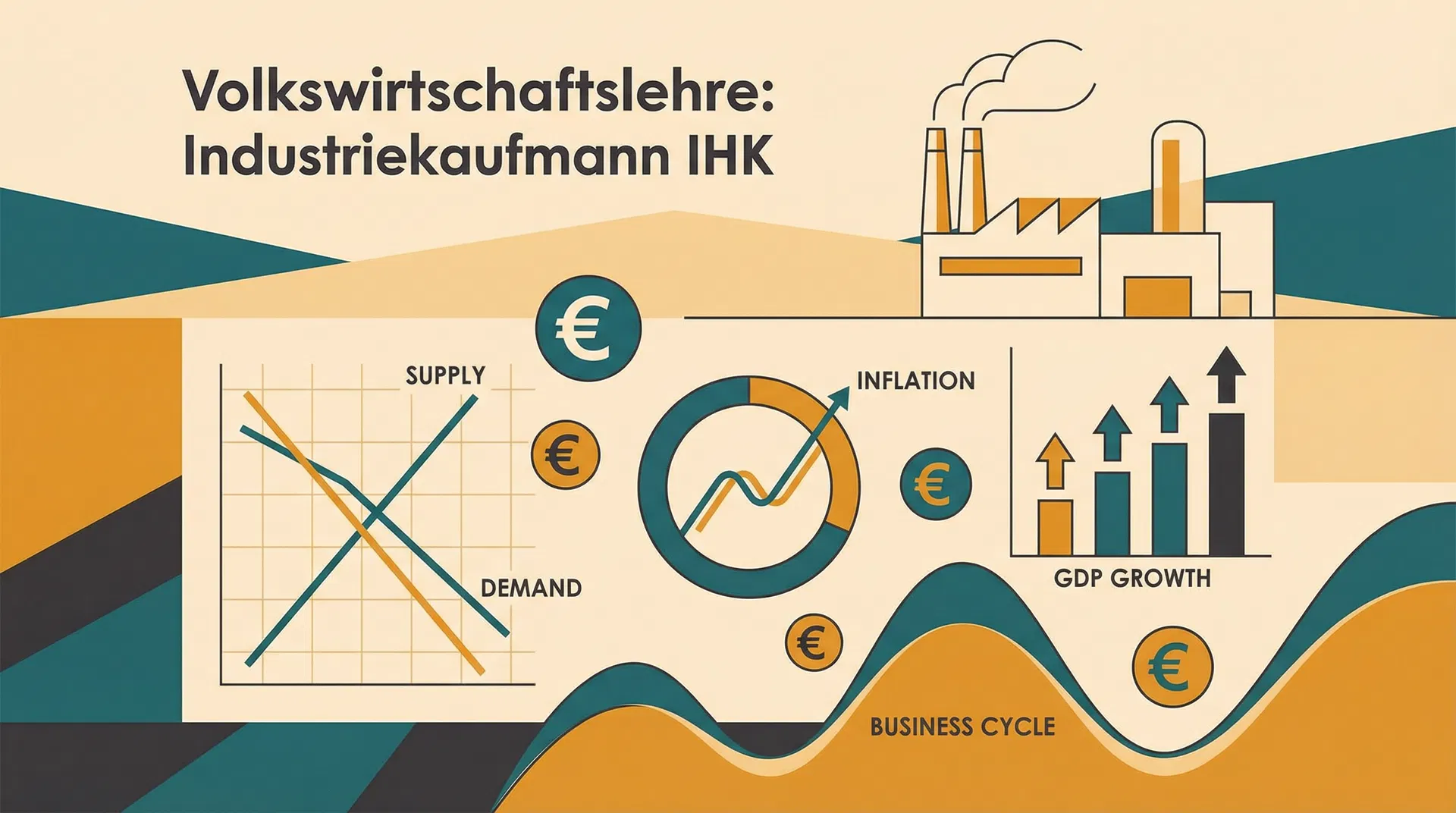
Volkswirtschaftslehre für Industriemeister: Konjunktur, Inflation & Wirtschaftspolitik einfach erklärt
Entschlüssle die Geheimnisse von Konjunktur, Inflation und Wirtschaftspolitik. Erfahre, warum VWL für Industriemeister entscheidend ist und wie du dieses Wissen für deine Karriere nutzt.
Read more
Arbeitsrecht für Industriemeister: Die 20 wichtigsten Paragraphen
Als Industriemeister sind Sie Führungskraft und Arbeitnehmer zugleich. Unser Artikel erklärt die 20 wichtigsten Paragraphen aus KSchG, ArbZG, MuSchG & BetrVG, die Sie für einen rechtssicheren Arbeitsalltag kennen müssen.
Read more