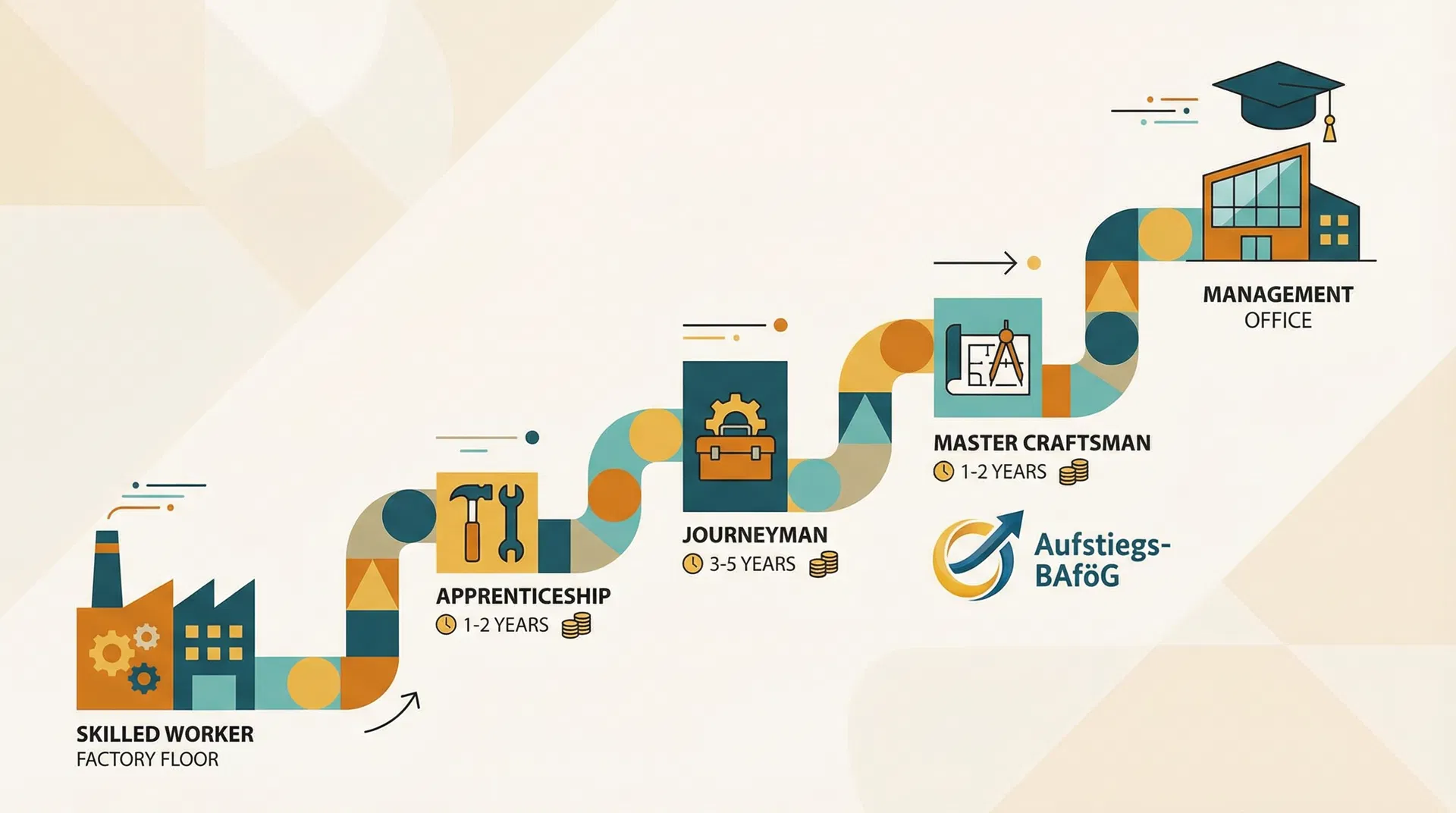
From Skilled Worker to Master Craftsman: Your Career Plan with Timeline and Costs
The journeyman's certificate is in hand, the first years of professional experience have been gathered – what now? Many skilled workers reach a point where they ask themselves: Is that all there is? If you are striving for more responsibility, new challenges, and a significantly better salary, then further training to become a master craftsman is your ticket to the next career league. The master craftsman title is not only a recognized qualification, but also a real career springboard that opens doors to leadership positions, self-employment, and a higher income.
This article is your personal career plan. We will show you practically and step-by-step how to successfully master the path from skilled worker to master craftsman. You will learn everything about the prerequisites, the time planning, and the costs involved. We will also give you a detailed overview of financing options so that your dream of a master craftsman title does not fail due to money.
Setting the Course: Prerequisites for the Master Craftsman Examination
Before you can start your master craftsman training, you must meet certain formal requirements. The good news is: The hurdles are surmountable for most skilled workers with professional experience. The exact requirements may vary slightly depending on the craft or industrial profession and federal state, but in essence, they are very similar.
The most important prerequisite is usually a successfully completed journeyman's examination in the craft in which you aspire to the master craftsman title, or a final examination in a recognized apprenticeship. Building on this, several years of professional experience are usually required. As a rule of thumb, two to three years are often cited here, but there are also industry-specific differences. In some cases, it is even possible to be admitted to the master craftsman examination without a journeyman's certificate if you can prove many years of relevant professional activity. In such cases, individual advice from the responsible Chamber of Crafts (HWK) or Chamber of Industry and Commerce (IHK) is always recommended.
| Prerequisite | Description |
|---|---|
| Training Qualification | Successfully completed journeyman's examination or final examination in a recognized apprenticeship. |
| Professional Experience | Usually 2-3 years of relevant professional experience after training. The exact duration varies. |
| Special Admission | In exceptional cases, admission is possible through many years of relevant professional activity, even without a formal professional qualification. |
Your Roadmap to Master Craftsman: Timeline for Further Education
The decision for master craftsman training is also a decision about your future rhythm of life. The central question is: Full-time or part-time? Both models have their advantages and disadvantages, and the choice depends heavily on your personal life situation, your financial possibilities, and your learning speed.
The full-time option is the fastest way to the master craftsman's certificate. You concentrate entirely on further education and can usually obtain the qualification within 9 to 12 months. However, this also means that you will leave professional life for this period and have to forgo your regular salary. On the other hand, you will reach your goal faster and can benefit from the advantages of the master craftsman title sooner.
The part-time option is the more popular choice for many working professionals. You complete the master craftsman courses alongside your job, usually in the evenings or on weekends. This saves money, as you continue to receive your salary. However, this model requires a lot of discipline and perseverance, as the double burden of work and study should not be underestimated. The duration of part-time master craftsman school usually extends over 2 to 3 years.
| Model | Duration | Advantages | Disadvantages |
|---|---|---|---|
| Full-time | 9-12 months | Faster completion, full concentration on training | No salary, higher living costs |
| Part-time | 2-3 years | Financial security through continuous salary | High double burden, longer overall duration |
Your timeline to the master craftsman title could look like this:
- Phase 1: Orientation & Decision (6-12 months before start): Inform yourself comprehensively about the different master craftsman schools, course models, and financing options. Talk to your employer and family about your plans.
- Phase 2: Registration & Financing (3-6 months before start): Register with the master craftsman school of your choice and clarify the financing. Apply for the Upgrading BAföG and possibly other funding.
- Phase 3: Master Craftsman Training (Duration depending on model): Now it's time for the nitty-gritty! Attend the courses, study for the exams, and expand your specialized knowledge.
- Phase 4: The Master Craftsman Examination: Prove your skills in the four parts of the master craftsman examination.
- Phase 5: The Master Craftsman's Certificate: Congratulations! You have made it and hold your master craftsman's certificate in your hands – the starting signal for your new career.
What Does the Master Craftsman Cost? A Detailed Overview of the Investment
Further training to become a master craftsman is an investment in your future that pays off in the long run. Nevertheless, it is important to calculate the costs realistically. The total costs for the master craftsman's certificate can vary considerably depending on the trade, master craftsman school, and chosen time model. Roughly estimated, the costs range from 5,000 to 15,000 Euros.
The main cost blocks are composed as follows:
- Course fees: This is the largest item and covers the costs of instruction at the master craftsman school.
- Examination fees: Separate fees are incurred for taking the four examination parts at the HWK or IHK.
- Learning materials: Textbooks, scripts, and possibly required software or tools incur additional costs.
- Living expenses: Especially with full-time further education, you will have to cover your ongoing costs for rent, food, and insurance without regular income.
To give you a better idea, here is an example cost breakdown for an Industrial Master Craftsman Metal (IHK) part-time:
| Cost Item | Estimated Costs |
|---|---|
| Course fees (Part I + II) | approx. €5,500 |
| Course fees AEVO (Part IV) | approx. €500 |
| Examination fees | approx. €800 |
| Learning materials | approx. €400 |
| Total Costs | approx. €7,200 |
Financial Support: How to Cover the Costs for Your Master Craftsman
The good news is: You don't have to bear the costs for your master craftsman alone. The state and other institutions support you with various funding programs. By far the most important and well-known instrument is the Upgrading BAföG (formerly Master BAföG).
The Upgrading BAföG is a combination of a state subsidy and a low-interest loan from KfW Bank. Basically, anyone who meets the admission requirements for a recognized advanced training course such as the master craftsman is eligible. The funding is independent of income and assets.
Since the last reform in 2020, the Upgrading BAföG has become even more attractive. You receive a subsidy of 50% on the course and examination fees. The remaining 50% can be applied for as a low-interest loan from KfW. If you pass the examination, 50% of the loan will be waived. In the end, you only have to bear 25% of the training costs yourself!
In addition to the Upgrading BAföG, there are other financial aids:
- Master Craftsman Bonus: In some federal states (e.g., Bavaria, Saxony), successful graduates of the master craftsman examination receive an additional premium of up to 3,000 Euros.
- KfW Loans: KfW offers further low-interest educational loans.
- Scholarships: Talented and committed craftsmen can apply for various scholarships, e.g., the Further Education Scholarship of the Foundation for the Promotion of Talented Young People in Vocational Education (SBB).
- Employers: Many companies support their employees in master craftsman training, either through financial subsidies or by granting leave from work.
| Funding Opportunity | Type of Funding | Main Advantage |
|---|---|---|
| Upgrading BAföG | Subsidy & Loan | Up to 75% of costs covered |
| Master Craftsman Bonus | Premium | Additional financial reward after passing the exam |
| KfW Loan | Low-interest loan | Flexible financing option |
| Scholarship | Grant | Financial support for particularly talented individuals |
| Employer Funding | Subsidy / Leave | Direct support from the company |
Mastering the Master Craftsman Examination: The Four Parts to Success
The master craftsman examination is the last hurdle on your way to the master craftsman title. It is demanding, but with good preparation, it is absolutely achievable. The examination is divided into four independent parts, which you can take in a prescribed order or individually.
-
Part I: The practical examination: Here you demonstrate your masterful practical skills. Typically, you have to plan, execute, and document a master craftsman project. This could be, for example, the production of a complex workpiece, the planning of a demanding customer job, or the solution of a technical problem.
-
Part II
Tags:
Read more
Other articles that might interest you

Betriebswirt IHK: Lohnt sich die Weiterbildung nach dem Meister?
Der Meister ist geschafft, doch was kommt danach? Erfahren Sie, warum der Betriebswirt IHK der logische nächste Schritt für Ihre Karriere ist und welche Chancen sich Ihnen damit eröffnen.
Read more
Industriemeister Gehalt 2025: Was verdienst du wirklich nach der Weiterbildung?
Die Weiterbildung zum Industriemeister ist eine lohnende Investition. Erfahre hier, welche Faktoren dein Gehalt beeinflussen und wie du es aktiv steigern kannst.
Read more
Industriemeister Elektrotechnik vs. Metall: Welche Fachrichtung passt zu dir?
Du stehst vor der Entscheidung zwischen Industriemeister Elektrotechnik und Metall? Unser umfassender Vergleich hilft dir, die richtige Wahl für deine Karriere zu treffen.
Read more