-
Setting the Course for the Future: Industrial Master Electrician or Metal?
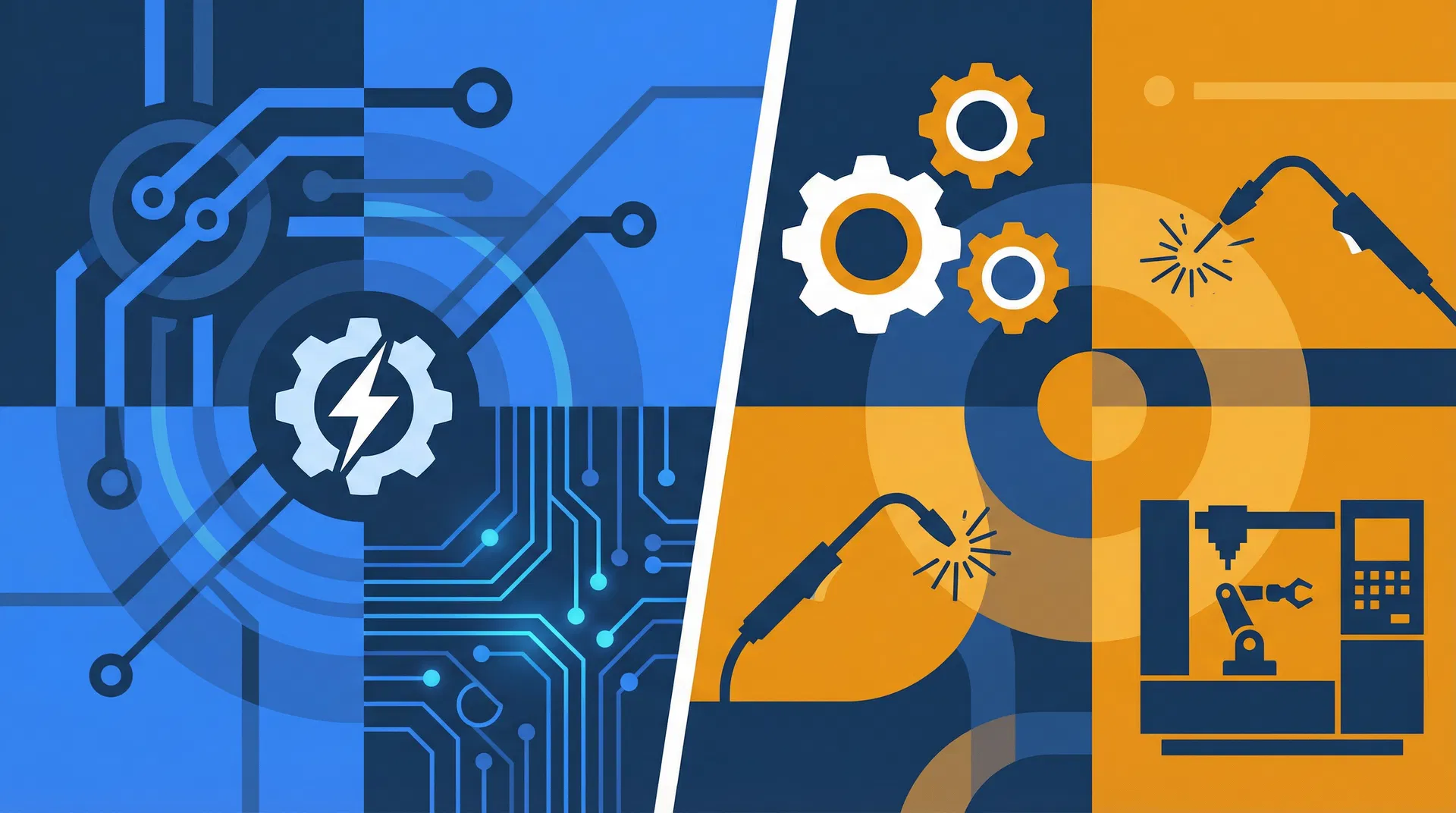
The decision is made: You want to take the next career step and aim for the respected title of Industrial Master. An excellent choice, because qualified managers are in greater demand than ever in German industry. But with the decision for the master's path often comes the next crucial question: Which specialization is right for me? Especially the choice between the two technical heavyweights, the Industrial Master Electrician and the Industrial Master Metal, presents many aspiring managers with a challenge. Both qualifications open up excellent career paths, but they differ fundamentally in their content, daily tasks, and the industries in which you will later work. This article serves as your personal compass in the world of industrial masters. We illuminate the content, career opportunities, salary prospects, and future outlook of both specializations to provide you with a sound basis for decision-making. Find out which path not only suits your skills but also your passions.
-
What is an Industrial Master? The Foundation of Your Career
Before we delve into the specific specializations, let's take a brief look at what distinguishes the industrial master as such. The title "Certified Industrial Master" is a nationally recognized and highly respected advanced training that prepares you for taking on specialist and management tasks in industrial companies. As an industrial master, you are the crucial link between the management level and the skilled workers in production. You are responsible for smooth production processes, the quality of products, and above all, for leading and motivating your employees. The master craftsman's examination, taken before the Chamber of Industry and Commerce (IHK), certifies not only in-depth technical and business knowledge but also professional and work-pedagogical suitability (AEVO) for training young professionals. In short: The industrial master is your ticket to a responsible position with excellent future prospects.
-
The Industrial Master Electrician: Electrified into the Future
The world of electrical engineering is the pulsating heart of modern industry. From automation technology to energy supply to information technology – without electrical and electronic systems, production stands still. As an industrial master specializing in electrical engineering, you are the expert who not only understands these complex systems but also plans, optimizes, and maintains them.
Typical Tasks and Industries
Your areas of application are as diverse as electrical engineering itself. You will find exciting tasks in the automotive industry, in mechanical and plant engineering, in the energy industry, or in the IT and communication sector. Your daily work could include the planning and project management of electrical systems, the supervision of the assembly and commissioning of robot systems, ensuring energy efficiency in production processes, or quality assurance of electronic components. You are a problem solver, organizer, and leader all in one.
Salary and Future Prospects
The high demand for skilled workers in electrical engineering is also reflected in the salary. According to Stepstone, the average annual salary for an Industrial Master Electrician is approximately €52,800, with a range that can extend from €44,000 to over €62,000 depending on experience, company size, and region. The future prospects are excellent. Topics such as the energy transition, electromobility, and advancing digitalization (Industry 4.0) ensure that the demand for qualified Industrial Master Electricians will continue to rise in the coming years.
-
The Industrial Master Metal: Master of Materials and Processes
The metal industry is the backbone of the German economy. Whether in vehicle construction, mechanical engineering, or metal processing – this is where products known worldwide for their quality are created. As an industrial master specializing in metal, you are the specialist for all processes related to the processing and finishing of metals. You master the materials, know the manufacturing processes, and know how to design production processes efficiently and with high quality.
Typical Tasks and Industries
Your expertise is particularly in demand in mechanical and plant engineering, in the automotive and supplier industry, in steel and metal construction, and in aerospace technology. Your core tasks include planning and controlling production processes, optimizing machining or forming processes, leading teams in the workshop, monitoring compliance with quality standards, and calculating production orders. You are the guarantor of efficiency and precision in the metalworking industry.
Salary and Future Prospects
In the metal sector, too, you can expect an attractive salary. The IM Online Campus states an average annual salary of around €57,300 for 2025. The salary range here is even broader and can, depending on factors such as professional experience and personnel responsibility, range from approx. €41,000 to over €83,000. Particularly experienced masters with more than ten years in the profession and personnel responsibility can achieve salaries beyond €66,000. The future prospects are also very good. Even if the industry is undergoing change, innovative manufacturing technologies, new materials, and lightweight construction are central topics for which qualified managers such as the Industrial Master Metal are indispensable.
-
The Direct Comparison: Electrical Engineering vs. Metal at a Glance
To help you make a decision, we have contrasted the most important aspects of the two specializations in a clear table:
| Feature | Industrial Master Electrician | Industrial Master Metal |
|---|---|---|
| Contents of further training | Electrical engineering, control technology, automation, IT systems | Materials science, manufacturing technology, assembly technology, machine theory |
| Typical tasks | Planning, installing and maintaining electrical systems, programming | Planning, controlling and monitoring manufacturing processes, personnel management |
| Difficulty (subjective) | Often perceived as mathematically and abstractly demanding | Considered practical and craft-oriented, but requires deep process understanding |
| Salary potential (average) | approx. €52,800 / year | approx. €57,300 / year |
| Future prospects | Very high due to digitalization, energy transition and e-mobility | Very high due to innovations in manufacturing, materials and lightweight construction |
-
Which Specialization Burns in You? A Decision Aid
The table shows: Both paths are promising. The choice should therefore primarily depend on your personal interests and strengths. Ask yourself the following questions:
- What fascinates you more? The idea of complex circuits that bring an entire system to life, or the idea of creating a high-precision component from a raw piece of metal?
- What are your strengths? Are you a tinkerer who likes to think logically and abstractly, or a practitioner who prefers to get hands-on and optimize processes?
- Imagine your daily work: Do you see yourself more in the cleanroom analyzing microchips or in the production hall where tons of machines shape tons of components?
A practical example:
Imagine a car manufacturer developing a new electric car. The Industrial Master Electrician would be responsible for the conception and integration of the electric powertrain, the battery, and the entire vehicle electronics. He ensures that all components work together perfectly.
The Industrial Master Metal, on the other hand, would be responsible for the production of the body parts. He optimizes the pressing tools, ensures the quality of the welds, and ensures that production runs efficiently and smoothly.
Both are indispensable for the success of the project, but their tasks and perspectives are fundamentally different.
-
Your Path to Success: With meister.jetzt for Perfect Preparation
No matter which specialization you choose, excellent preparation for the demanding IHK examination is the key to success. This is where meister.jetzt comes in. Our innovative online learning platform is specially tailored to the needs of aspiring industrial masters. We offer you everything you need for successful exam preparation:
- Flexible learning: Learn when and where you want. Our learning content is available 24/7 on all devices.
- Practical content: Our experienced lecturers provide you with exactly the knowledge you need for the exam and in your daily work.
- Realistic exam simulation: With our sample exams [blocked], you test your knowledge under real exam conditions.
- Strong community: Exchange ideas with other aspiring masters and learn together as a team.
Find out about our fair prices [blocked] and register [blocked] today. Start learning [blocked] directly and convince yourself.
Are you ready to take the next step? Test meister.jetzt now for 3 days completely free and without obligation!
-
FAQ – The Most Frequent Questions at a Glance
Can I still change my specialization after starting the further training?
A change is generally possible, but often involves effort and costs. The basic subjects (BQ part) are identical for both specializations. A change is therefore easiest before starting the action-specific part (HQ part). It is best to talk to your training provider early on.
What prior knowledge is helpful for the respective specialization?
For the Industrial Master Electrician, a completed apprenticeship in an electrical profession (e.g., electronics technician for industrial engineering) and a good mathematical-physical understanding are ideal. For the Industrial Master Metal, an apprenticeship in a metal profession (e.g., industrial mechanic, cutting machine operator) is the perfect basis.
Are there also combination possibilities or overlaps?
In modern industry, the boundaries are increasingly blurring. The profession of mechatronics technician is the best example of this. Even if the master craftsman examinations are separate, in everyday working life you will deal with mechanical components as an Industrial Master Electrician and encounter automated, electrically controlled systems as an Industrial Master Metal. However, specialization is still the usual and recommended path.
-
Conclusion: Your Path, Your Decision, Your Future
The choice between the Industrial Master Electrician and the
Tags:
Read more
Other articles that might interest you

Betriebswirt IHK: Lohnt sich die Weiterbildung nach dem Meister?
Der Meister ist geschafft, doch was kommt danach? Erfahren Sie, warum der Betriebswirt IHK der logische nächste Schritt für Ihre Karriere ist und welche Chancen sich Ihnen damit eröffnen.
Read more
Industriemeister Gehalt 2025: Was verdienst du wirklich nach der Weiterbildung?
Die Weiterbildung zum Industriemeister ist eine lohnende Investition. Erfahre hier, welche Faktoren dein Gehalt beeinflussen und wie du es aktiv steigern kannst.
Read more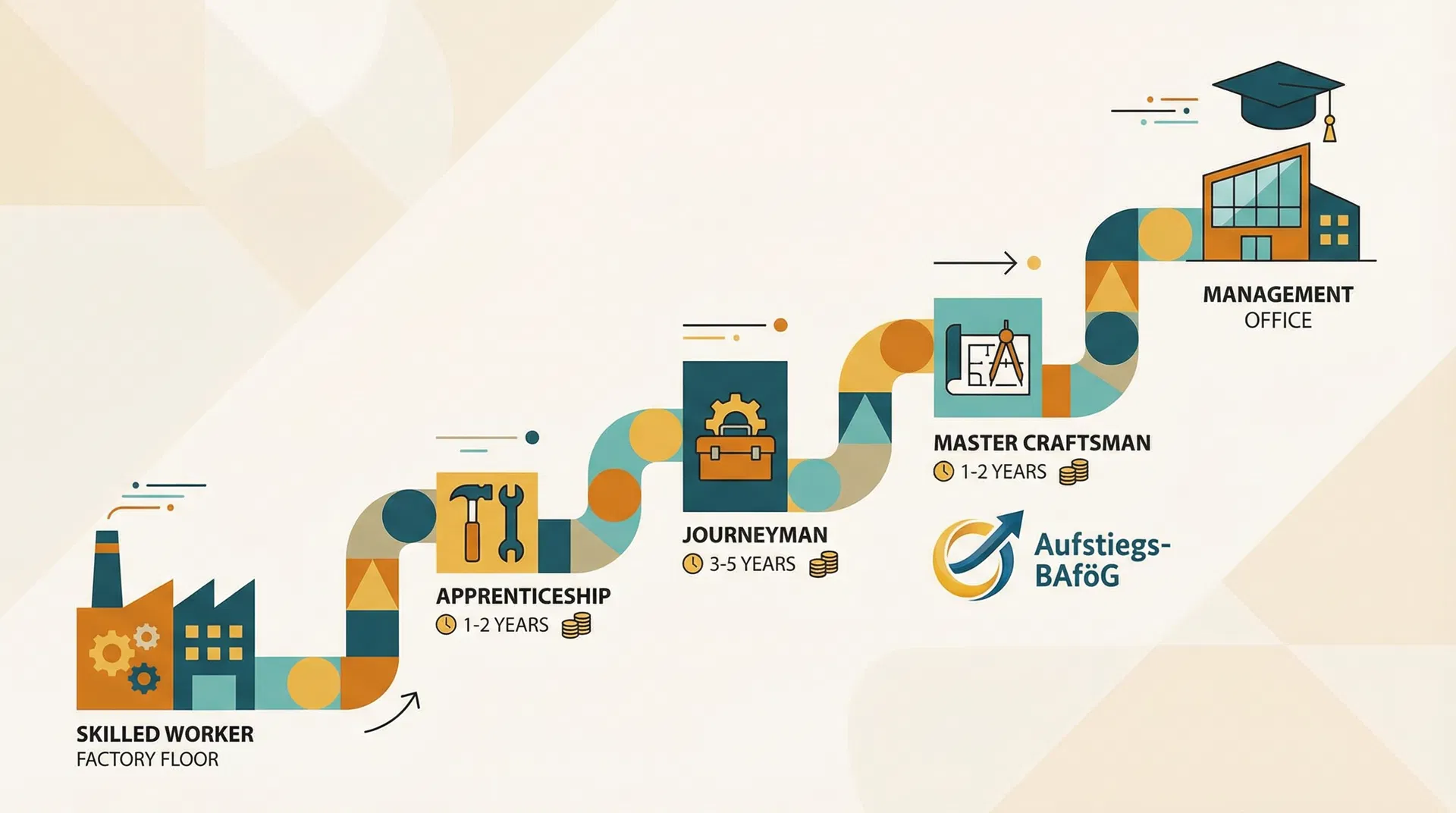
Vom Facharbeiter zum Meister: Dein Karrierefahrplan mit Zeitplan und Kosten
Der Meistertitel ist dein Ticket in die nächste Karriere-Liga. Dieser Artikel ist dein praxisnaher Fahrplan zu mehr Verantwortung, Gehalt und neuen Chancen.
Read more