Investment Appraisal for Foremen: Calculating Net Present Value, Payback, and Profitability
Introduction: Why Investment Appraisal is Crucial for You as an Aspiring Foreman
Imagine you're a newly appointed industrial foreman in a medium-sized company. Management approaches you and says, "We're planning to purchase a new CNC machine for €500,000. Is it worth it? You have one week to give us a well-founded recommendation." Phew. That's a tall order. This is exactly where investment appraisal comes into play. It's not a dry business administration topic for an ivory tower, but your practical tool to support such business decisions with facts, figures, and data.
For your IHK examination, investment appraisal is a central component of the "Business Administration" subject. But more importantly: In your future role as a manager, you will repeatedly find yourself in a position where you have to evaluate, compare, and justify investments. Whether it's a new machine, new software, or an entire production line – with the methods of investment appraisal, you speak the language of management and demonstrate your business competence. This article is your practical guide to understanding the most important procedures – Net Present Value method, Payback Period, and Profitability Calculation – not just for the exam, but to apply them confidently in your daily work as a foreman.
Static Methods: The Quick Check for Your Investment
The static methods of investment appraisal are, so to speak, the "quick check" for your investment decision. They are simpler and faster to calculate than dynamic methods because they ignore the time value of money (i.e., interest and compound interest). They always consider only a single period, usually the first year after the investment. For a first, quick assessment, they are often perfectly adequate.
Cost Comparison Method: What Costs Less?
The cost comparison method is the simplest approach. You simply compare the costs of two or more investment alternatives. The alternative with the lowest average annual costs is the most advantageous.
Example: Your company wants to purchase a new forklift. You have the choice between Model A (electric) and Model B (diesel).
| Cost Type | Model A (Electric) | Model B (Diesel) |
|---|---|---|
| Acquisition Costs | €30,000 | €25,000 |
| Useful Life | 8 years | 8 years |
| Calculated Depreciation p.a. | €3,750 | €3,125 |
| Energy Costs p.a. | €1,500 | €3,000 |
| Maintenance Costs p.a. | €1,000 | €1,800 |
| Total Costs p.a. | €6,250 | €7,925 |
Conclusion: Although Model A is more expensive to acquire, it incurs lower annual costs. According to the cost comparison method, Model A would be the better choice.
Profit Comparison Method: What Brings More Revenue?
This method extends the cost comparison method to include revenues. You compare not only the costs but also the profit (revenues - costs) of the alternatives.
Example: Let's assume the electric forklift (Model A) can generate additional revenues of €2,000 per year due to its higher efficiency, while the diesel forklift (Model B) can only generate €1,500.
- Profit Model A: €2,000 (Revenues) - €6,250 (Costs) = -€4,250 (Loss)
- Profit Model B: €1,500 (Revenues) - €7,925 (Costs) = -€6,425 (Loss)
Conclusion: Model A also performs better here, as the loss is smaller.
Profitability Calculation: How Well Does Your Capital Yield Returns?
The profitability calculation relates the profit to the capital employed. It answers the question: What percentage return does my investment generate per year? The formula is:
Profitability = (Profit + Imputed Interest) / (Average Capital Employed) * 100*
You calculate the average capital employed as follows: (Acquisition Costs / 2).
Example (Model A):
- Profit: -€4,250
- Imputed Interest (assuming 5% on average capital employed): (€30,000 / 2) * 0.05 = €750
- Average Capital Employed: €30,000 / 2 = €15,000
- Profitability Model A: (-€4,250 + €750) / €15,000 * 100 = -23.33 %
The result is negative because, in this example, we generate a loss. In practice, you would only make an investment if the profitability is above a minimum interest rate set by the company.
Static Payback Period: When Has the Investment Paid Off?
The payback period (also known as the payback method) determines the period in which the invested capital has been recovered through annual profits and depreciation. The question is: How long does it take until I get my money back?
Payback Period = Acquisition Costs / (Profit per year + Depreciation per year)
Example (Model A):
- Acquisition Costs: €30,000
- Profit p.a.: -€4,250
- Depreciation p.a.: €3,750
- Payback Period Model A: €30,000 / (-€4,250 + €3,750) = -60 years
The negative result shows that, under these assumptions, the investment would never pay back. This is a clear signal to reconsider the investment or to review the assumptions (e.g., revenues).
Dynamic Methods: Considering Time
Dynamic methods are more accurate than static ones because they consider the time value of money. The basic idea is simple: €100 today is worth more than €100 in a year. Why? Because you could invest the €100 today and earn interest on it. Dynamic methods therefore discount all future payments to the present day (or compound them) to make them comparable. This is called discounting.
Net Present Value (NPV) Method: The Gold Standard
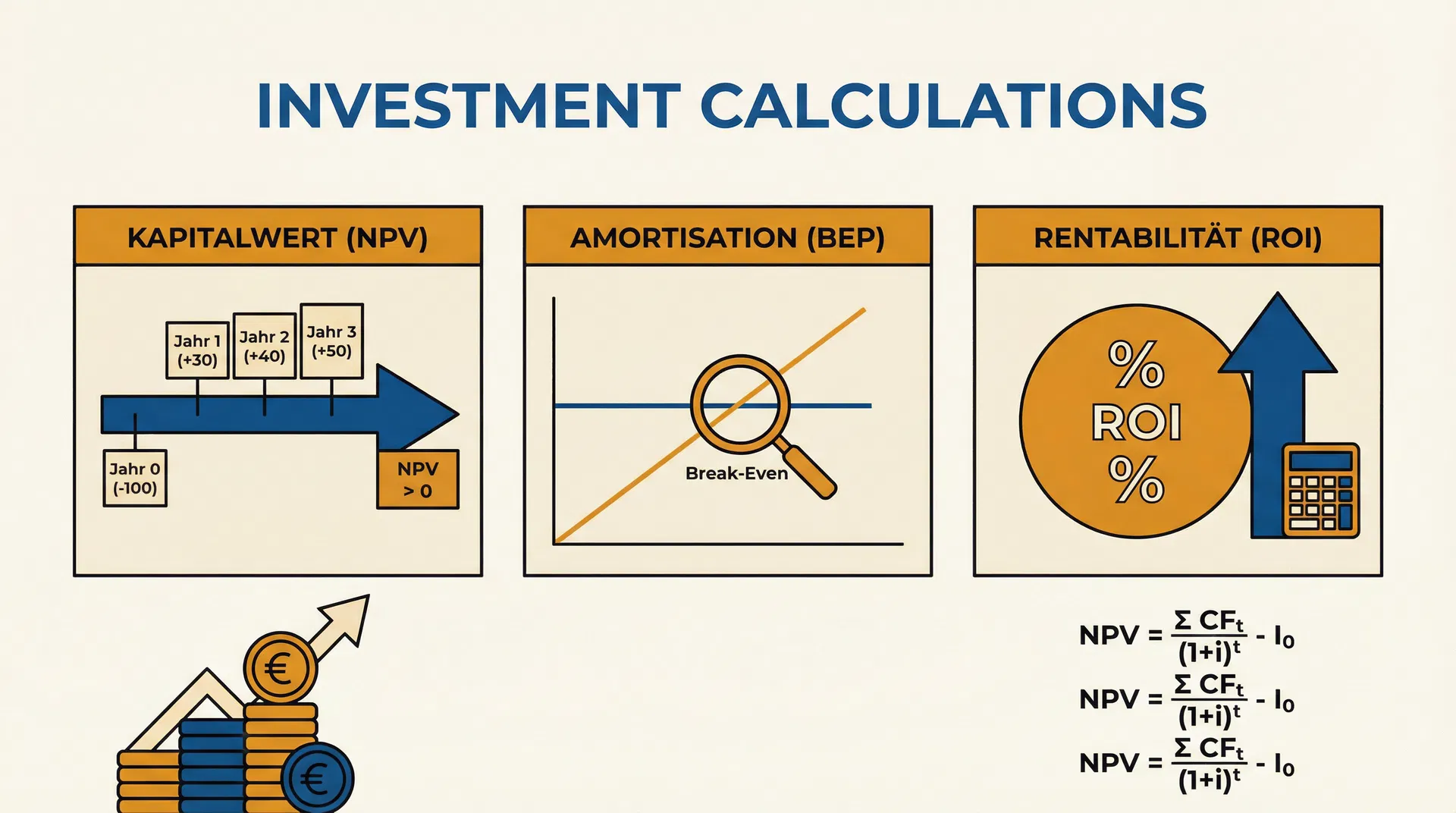
The Net Present Value method is the most important and most meaningful method of investment appraisal. It answers the question: What is the value of my investment today? To do this, all future inflows and outflows of an investment are discounted to the present day and summed up. The acquisition outflow is then subtracted.
- NPV > 0: The investment is advantageous. It generates more than the required minimum return.
- NPV = 0: The investment generates exactly the required minimum return. One is indifferent.
- NPV < 0: The investment is disadvantageous. Stay away!
Example: A new machine costs €100,000. It is expected to generate the following cash flows over 5 years. The discount rate is 8%.
| Year | Cash Flow | Discount Factor (1/(1+0.08)^n) | Present Value of Cash Flow |
|---|---|---|---|
| 1 | €30,000 | 0.926 | €27,780 |
| 2 | €35,000 | 0.857 | €29,995 |
| 3 | €40,000 | 0.794 | €31,760 |
| 4 | €30,000 | 0.735 | €22,050 |
| 5 | €25,000 | 0.681 | €17,025 |
| Sum of Present Values | €128,610 |
Calculation of Net Present Value:
NPV = Sum of Present Values - Acquisition Costs NPV = €128,610 - €100,000 = €28,610
Conclusion: The Net Present Value is positive. The investment is therefore very advantageous and should be carried out. It not only yields an 8% return on the invested capital but also generates a present value of €28,610.
Internal Rate of Return (IRR) Method
The internal rate of return is the discount rate at which the Net Present Value of an investment is exactly zero. It therefore indicates the actual, effective return of an investment. To make a decision, you compare the internal rate of return with your discount rate (your minimum required return).
- IRR > Discount Rate: The investment is advantageous.
- IRR < Discount Rate: The investment is disadvantageous.
Calculating the internal rate of return is complex and is usually done in practice using spreadsheet programs (e.g., using the =IRR() function in Excel). For the exam, you need to understand the principle and often determine it by estimating and trying out two interest rates.
Dynamic Payback Period: When
Tags:
Read more
Other articles that might interest you
Kostenstellenrechnung & BAB einfach erklärt: Dein Guide für 2025
Verstehe die Kostenstellenrechnung und den Betriebsabrechnungsbogen (BAB) Schritt für Schritt. Lerne, Gemeinkosten zu verteilen und Zuschlagssätze für deine Kalkulation zu berechnen – praxisnah und einfach erklärt.
Read more
Kostenrechnung für Industriemeister: Alles was du wissen musst
Die Kostenrechnung ist einer der wichtigsten Prüfungsbereiche für angehende Industriemeister. Von der Kostenartenrechnung über den BAB bis zur Deckungsbeitragsrechnung – hier findest du die komplette Zusammenfassung.
Read more
AEVO-Prüfung bestehen: Der ultimative Leitfaden 2025
Die Ausbildereignungsprüfung (AEVO) ist Pflicht für alle, die ausbilden wollen. Erfahre alles über Prüfungsablauf, Handlungsfelder, praktische Unterweisung und die besten Vorbereitungsstrategien.
Read more