Imagine you are the captain of a large ship. You not only need to know how much fuel you consume in total, but also which engine needs how much to stay on course. This is exactly what cost center accounting does for a company. It is a crucial instrument of internal cost and performance accounting and helps to analyze the economic efficiency of individual business areas. A central tool for this is the cost allocation sheet, or BAB for short (Betriebsabrechnungsbogen). In this article, we will explain step-by-step how cost center accounting works, how to create a BAB, and how to determine the important overhead rates for your calculations. Ready to uncover and control the costs in your company? Then let's get started!
What is Cost Center Accounting and Why is it So Important?
Cost center accounting is a central component of internal accounting and a sub-area of cost and performance accounting (KLR). Its main task is to allocate the overhead costs incurred in the company to the individual cost centers according to their cause. But what exactly does that mean?
- Overhead costs: These are costs that cannot be directly assigned to a single product or service. Think of the rent for the production hall, the salaries of the administration, or the electricity costs for lighting. They are also called indirect costs.
- Cost centers: These are the locations in the company where costs arise and services are provided. A classic division is into material, production, administration, and sales. Depending on the company size and structure, this breakdown can also be much more detailed (e.g., production unit A, production unit B, marketing, human resources department, etc.).
Cost center accounting thus answers the question: Where in the company have which costs been incurred and to what extent?
This transparency is essential for aspiring master craftsmen and business economists for several reasons:
- Economic efficiency control: You can see exactly which departments are particularly cost-intensive and where there may be potential for savings.
- Accurate calculation: Only through the allocation of overhead costs via cost center accounting is an exact self-cost and price calculation for your products possible. Without it, you would be groping in the dark.
- Budgeting and planning: The recorded actual costs of a period are the basis for planning and budgeting for future periods.
- Accountability: By assigning costs to specific departments, responsibility for their compliance is also clearly regulated.
In short: Without clean cost center accounting, you lack the basis for many important business decisions. If you have your costs under control, you are well on your way to success. On our platform meister.jetzt [blocked] you will find numerous practice exercises and detailed explanations on this topic.
The Cost Allocation Sheet (BAB): The Heart of Cost Center Accounting
The cost allocation sheet (BAB) is the standard instrument for carrying out cost center accounting. It is a table that systematically distributes overhead costs to the individual cost centers. The goal of the BAB is to determine the overhead rates for the main cost centers (material, production, administration, sales). You will urgently need these overhead rates later for cost unit accounting, i.e., the calculation of your products.
Structure of a Cost Allocation Sheet
A BAB always has a similar structure. The rows contain the various types of overhead costs (e.g., auxiliary wages, salaries, rent, energy, depreciation). The columns contain the cost centers. A distinction is made here between auxiliary cost centers and main cost centers.
- Auxiliary cost centers (also called preliminary cost centers): They provide services for other cost centers in the company, but not directly for the products. Examples include the canteen, the vehicle fleet, the IT department, or energy supply.
- Main cost centers: They are directly involved in the creation of products or services. The classic four are material, production, administration, and sales.
The trick with the BAB is the internal service allocation. The costs of the auxiliary cost centers must ultimately be fully allocated to the main cost centers, because only these can pass on their costs to the products.
| Cost Type | Total Costs | Auxiliary Cost Center 1 (e.g., Canteen) | Auxiliary Cost Center 2 (e.g., Vehicle Fleet) | Main Cost Center 1 (Material) | Main Cost Center 2 (Production) | Main Cost Center 3 (Administration) | Main Cost Center 4 (Sales) |
|---|---|---|---|---|---|---|---|
| Auxiliary Wages | €15,000 | €5,000 | €3,000 | €2,000 | €5,000 | €0 | €0 |
| Salaries | €40,000 | €2,000 | €4,000 | €3,000 | €6,000 | €15,000 | €10,000 |
| Rent | €20,000 | €1,000 | €2,000 | €4,000 | €8,000 | €3,000 | €2,000 |
| ... | ... | ... | ... | ... | ... | ... | ... |
| Total Primary Overhead Costs | XX.XXX € | X.XXX € | X.XXX € | XX.XXX € | XX.XXX € | XX.XXX € | XX.XXX € |
| Allocation Auxiliary Cost Centers | |||||||
| Total Secondary Overhead Costs | XX.XXX € | 0 € | 0 € | XX.XXX € | XX.XXX € | XX.XXX € | XX.XXX € |
| Allocation Base | Production Material | Production Wages | Manufacturing Costs | Manufacturing Costs | |||
| Overhead Rate | XX % | XX % | XX % | XX % |
Table 1: Simplified structure of a cost allocation sheet.
Step-by-Step: How to Fill Out the BAB (with Calculation Example)
Now it gets practical! We will fill out a simplified BAB together. Imagine that "Meister-Möbel GmbH" produces high-quality office chairs. The following overhead costs were incurred for the month of October:
- Auxiliary wages: €20,000
- Salaries: €50,000
- Building rent: €30,000
- Depreciation on machinery: €15,000
- Office supplies: €5,000
- Total overhead costs: €120,000
These costs must now be distributed to the cost centers. For this, we need allocation keys.
Step 1: Primary Overhead Cost Allocation
First, we distribute the overhead cost types directly to the cost centers, as far as possible. This is called primary overhead cost allocation. For this, we use suitable allocation keys (e.g., salaries by number of employees, rent by used area).
Assumptions for our example:
| Cost Type | Allocation Key | Auxiliary Cost Center "Building Management" | Main Cost Center "Material" | Main Cost Center "Production" | Main Cost Center "Administration" | Main Cost Center "Sales" |
|---|---|---|---|---|---|---|
| Auxiliary Wages | Direct Recording | €8,000 | €4,000 | €8,000 | €0 | €0 |
| Salaries | Direct Recording | €5,000 | €5,000 | €10,000 | €20,000 | €10,000 |
| Rent | Area in sqm | €2,000 (100sqm) | €4,000 (200sqm) | €12,000 (600sqm) | €6,000 (300sqm) | €6,000 (300sqm) |
| Depreciation | Direct Assignment | €1,000 | €2,000 | €10,000 | €1,500 | €500 |
| Office Supplies | Direct Recording | €500 | €500 | €1,000 | €2,000 | €1,000 |
| Total Primary OH | €16,500 | €15,500 | €41,000 | €29,500 | €17,500 |
Table 2: Example of primary overhead cost allocation.
Step 2: Internal Service Allocation
Now comes the crucial step: The costs of the auxiliary cost center "Building Management" (€16,500) must be allocated to the main cost centers. This is called secondary overhead cost allocation. As a key, we again take the used area (excluding the area of the auxiliary cost center itself).
- Total area of the main cost centers:
Tags:
Read more
Other articles that might interest you
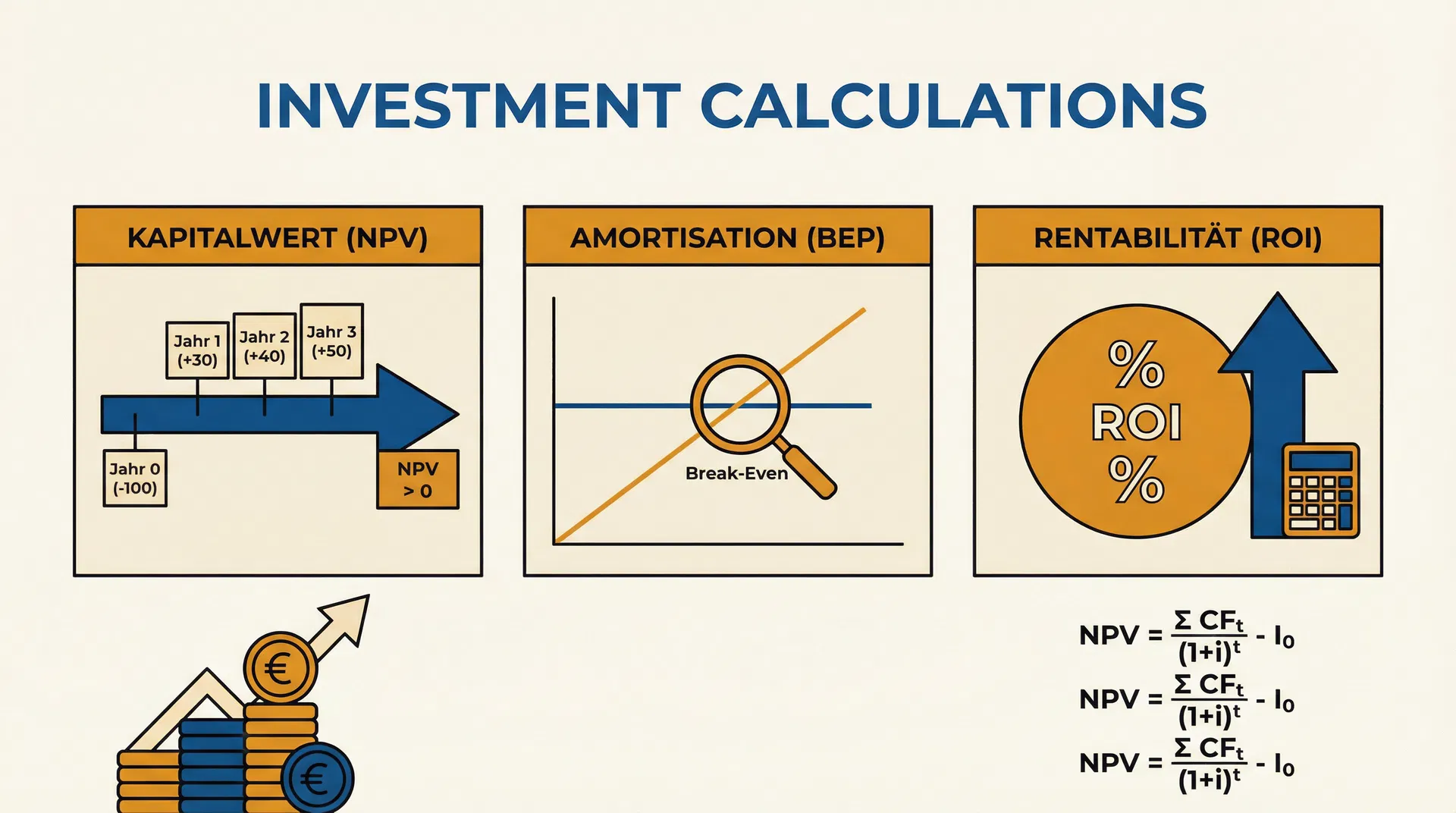
Investitionsrechnung für Meister: Kapitalwert, Amortisation & Rentabilität berechnen
Die Investitionsrechnung ist dein Handwerkszeug, um unternehmerische Entscheidungen mit Zahlen, Daten und Fakten zu untermauern. Lerne die wichtigsten Verfahren für deine Meisterprüfung und die Praxis.
Read more
Kostenrechnung für Industriemeister: Alles was du wissen musst
Die Kostenrechnung ist einer der wichtigsten Prüfungsbereiche für angehende Industriemeister. Von der Kostenartenrechnung über den BAB bis zur Deckungsbeitragsrechnung – hier findest du die komplette Zusammenfassung.
Read more
AEVO-Prüfung bestehen: Der ultimative Leitfaden 2025
Die Ausbildereignungsprüfung (AEVO) ist Pflicht für alle, die ausbilden wollen. Erfahre alles über Prüfungsablauf, Handlungsfelder, praktische Unterweisung und die besten Vorbereitungsstrategien.
Read more