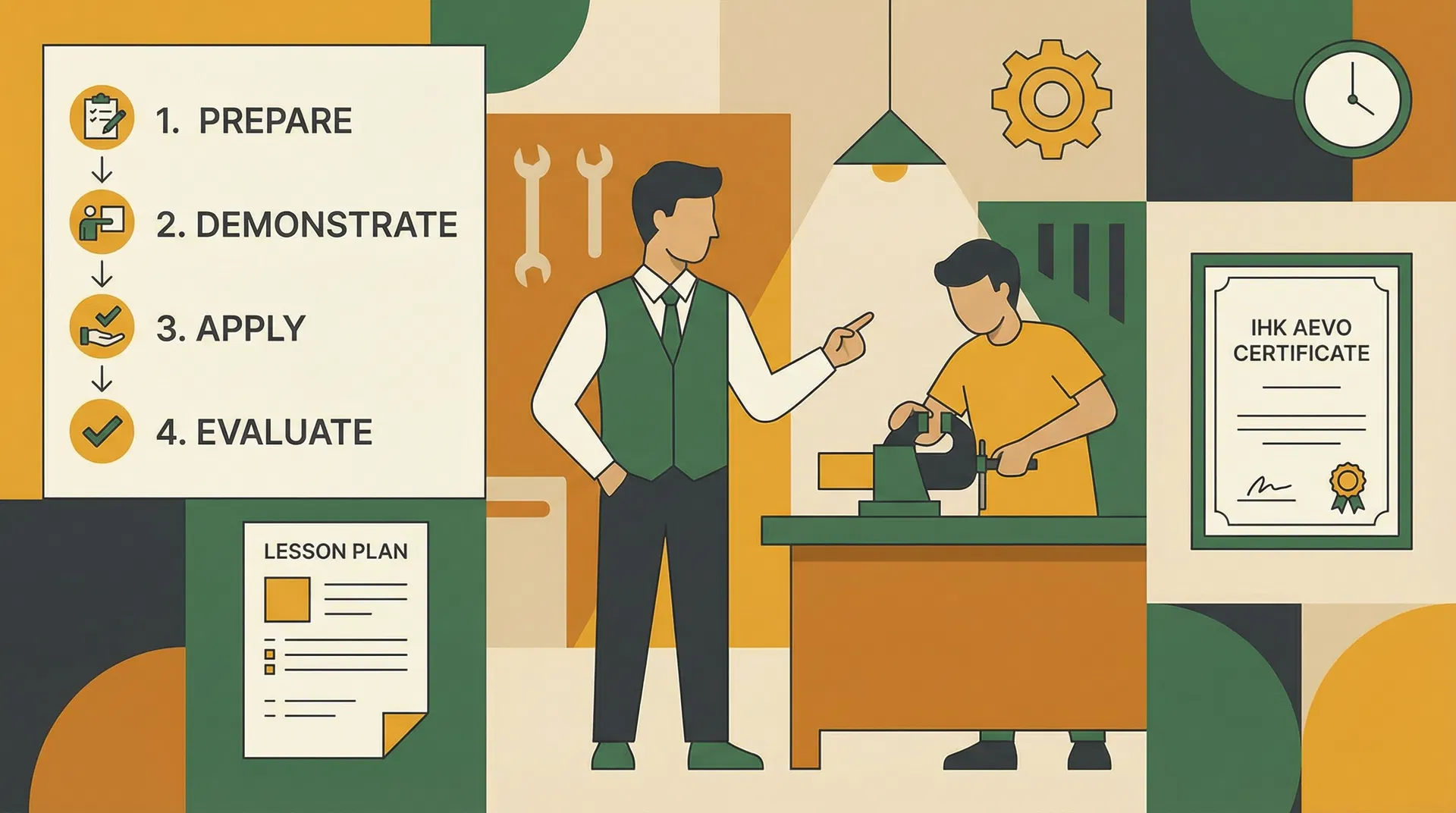
Practical instruction is the core of the AEVO examination for many aspiring trainers. This is where you show what you're made of: not only professionally, but also as a person and educator. Good preparation is the key to success. In this article, we'll guide you step-by-step through all phases of preparation, give you practical tips, and show you how to appear confident and convincing on exam day. Whether you prefer the formal "Sie" or informal "Du" address, we'll stick to the motivating "Du" here.
The AEVO Exam: An Overview of Practical Instruction
The practical examination according to the Instructor Aptitude Ordinance (AEVO) is your chance to prove that you have what it takes to be an instructor. It lasts a total of 30 minutes and is divided into two equally weighted parts: the presentation or practical execution of a training situation (15 minutes) and the subsequent technical discussion (15 minutes). So you have a choice: either you present a training concept or you demonstrate instruction live. Most candidates opt for practical instruction, as it is considered more action-oriented and often easier. Therefore, in this article, we will focus entirely on this approach.
What exactly is practical instruction?
Imagine practical instruction as a short, intensive role-play. You take on the role of the instructor and guide an "apprentice" to learn a specific, job-typical task. This apprentice can be a member of the examination committee, another candidate, or – depending on the IHK – a person you bring with you. Your goal is to show that you can independently plan, carry out, and monitor a training situation. It's not just about the "what" (the content), but above all about the "how" (the method).
The Methods: Your Tools as an Instructor
Various didactic methods are available for practical instruction. The best known and most frequently used is the 4-step method. It is particularly well suited for teaching practical skills. In addition, there is the instructional discussion, which is useful for explaining contexts and promoting understanding. But other methods such as exploration, role-playing, or the project method can also be useful depending on the topic and learning objective. Choosing the right method is a crucial part of your concept and will also be discussed in the technical discussion.
The Most Important Steps for Perfect Preparation
Careful preparation is half the battle. If you follow the following three steps, you will go into your AEVO exam well prepared and with a secure feeling.
Step 1: Choosing the Right Topic – The Basis of Your Success
Choosing the topic for your practical instruction is one of the most important decisions in the entire process. A good topic is the foundation for a convincing concept and successful execution. But what makes a good topic?
- Job-typical and relevant: Choose a task that is typical for the training occupation and appears in the training framework plan. It should be suitable for an apprentice in their first year of training.
- Not too complex, not too simple: The task should be realistically teachable within the given 15 minutes. A task that is too complex cannot be explained in such a short time, while a task that is too simple does not offer enough scope to demonstrate your pedagogical skills.
- Practical and illustrative: Ideally, it should be a practical activity that you can easily demonstrate and the apprentice can directly imitate. Abstract topics are often more difficult to convey.
- Your personal connection: Choose a topic that you know well and feel confident about. Your own enthusiasm and competence will radiate to the examination committee.
| Good Topic Examples | Bad Topic Examples |
|---|---|
| Correctly measuring a voltage with a multimeter (electrician) | The complete wiring of a control cabinet |
| Properly setting a table (restaurant specialist) | The entire organization of a large event |
| Manually checking an incoming invoice (industrial clerk) | The creation of the complete annual financial statements |
Important: Be sure to coordinate your topic with the responsible IHK in advance! This way, you can be sure that your topic is approved for the exam.
Step 2: Creating the Instruction Concept – Your Guiding Thread
The instruction concept is your script for the practical exam. Although it is generally not mandatory, it is strongly recommended by most IHKs and shows the examination committee that you have systematically planned your instruction. Submit the concept in triplicate on the day of the exam.
Your concept should be clear, well-structured, and meaningful. Here is a proven structure you can follow:
| Component | Content |
|---|---|
| 1. Cover Page | Your name, exam number, training occupation, topic of instruction, date |
| 2. Training Situation | Target group analysis: Who is the apprentice? (Age, year of training, prior knowledge) Technical analysis: What is the content of the instruction? Framework conditions: Where and when will the instruction take place? (Location, time, work materials) |
| 3. Training Concept (Procedure Plan) | Specific learning objectives: What should the apprentice be able to do specifically after the instruction? (e.g., "The apprentice can independently...") Methods: Which instruction method do you choose and why? (e.g., 4-step method) Work steps & learning content: Detailed procedure of the instruction in logical steps. Media & materials: What aids do you use? (Tools, materials, worksheets, etc.) Time: How much time do you plan for each step? Learning success control: How do you check whether the apprentice has achieved the learning objectives? |
| 4. Appendix | Copy of the relevant excerpt from the training framework plan (general learning objective), possibly worksheets or other media as a copy. |
Step 3: Practicing the Practical Execution – Routine Brings Confidence
The best concept is useless if you cannot present it convincingly. Therefore, practice your instruction several times, preferably under realistic conditions. Grab a colleague, a friend, or a family member as a "test apprentice" and play through the entire situation. Pay attention to the following points:
- Speaking freely: Avoid reading from your concept. Speak freely and in your own words. This appears more authentic and confident.
- Time management: Stop the time and try to stick to the 15 minutes as precisely as possible. Shorten or extend individual steps if necessary.
- Dealing with the "apprentice": Be patient, friendly, and motivating. Ask open questions to stimulate the learning process and actively involve the apprentice.
- Get feedback: Ask your test person for honest feedback. What was good? What could you improve? Where were there ambiguities? Use this feedback to optimize your instruction.
The more you practice, the more confident you will become. This will also help you to deal with stage fright and nervousness better on exam day.
Exam Day: Appearing Confident and Convincing
The big day is here! With good preparation, you have every reason to go into the exam self-assured. Here are a few final tips to ensure everything goes smoothly:
Your Checklist for Exam Day
- Documents: ID card, exam invitation, your instruction concept (3 copies), all necessary materials and media.
- Clothing: Choose an outfit in which you feel comfortable and that suits the occasion. Business attire is usually a good choice.
- Punctuality: Allow enough time for travel to avoid stress.
- Positive attitude: Go into the exam with a positive and optimistic attitude. You have prepared well and you will succeed!
In Dialogue with the Examiners: Mastering the Technical Discussion
The technical discussion following your instruction is not a knowledge query, but a conversation among experts. The examiners want to see that you can justify your decisions and reflect on your approach. Be prepared for questions such as:
- "Why did you choose this topic?"
- "For what reason did you choose the 4-step method? What alternatives would there have been?"
- "How did you formulate the learning objectives and how do you ensure that they are achieved?"
- "What would you do differently next time?"
Answer honestly and self-critically. Show that you have thought about it and also recognize possible weaknesses in your instruction. This demonstrates professionalism and the ability to reflect.
FAQ – Frequently Asked Questions about Practical Instruction
1. Do I have to submit a written concept?
In most cases, it is not mandatory but strongly recommended. It shows your professional preparation and serves as your guiding thread. It's best to check directly with your responsible IHK for the exact requirements.
2. What happens if I go over the 15 minutes?
A slight overrun is usually not a big deal but should be avoided. Good time management is part of the assessment. Therefore, practice adhering to the time limit beforehand.
3. Who plays the apprentice?
This varies from IHK to IHK. Often, an examiner or another exam participant takes on the role. Sometimes it is also allowed to bring your own person. Be sure to clarify this with your IHK in advance.
4. Which instruction method is the best?
There is no "best" method. The choice of method always depends on the learning objective, the content, and the apprentice. The 4-step method is a classic for practical skills, but the instructional discussion or other methods can also be the right choice depending on the situation.
5. How do I deal with a "
Tags:
Read more
Other articles that might interest you

AEVO-Prüfung bestehen: Der ultimative Leitfaden 2025
Die Ausbildereignungsprüfung (AEVO) ist Pflicht für alle, die ausbilden wollen. Erfahre alles über Prüfungsablauf, Handlungsfelder, praktische Unterweisung und die besten Vorbereitungsstrategien.
Read more
Die 4-Stufen-Methode in der AEVO-Prüfung: Eine Schritt-für-Schritt-Anleitung zum Erfolg
Meistern Sie die 4-Stufen-Methode in Ihrer AEVO-Prüfung! Unsere Schritt-für-Schritt-Anleitung mit Praxisbeispielen und Tipps zeigt Ihnen, wie Sie die Prüfer überzeugen.
Read more
Spaced Repetition und Karteikarten: Die wissenschaftlich bewiesene Lernmethode für die Meisterprüfung
Du steckst mitten in der Vorbereitung auf deine Meisterprüfung und die schiere Menge an Lernstoff fühlt sich überwältigend an? Lerne, wie du mit Spaced Repetition dein Wissen nachhaltig verankerst.
Read more