Spaced Repetition and Flashcards: The Scientifically Proven Learning Method for the Master Craftsman Exam
The Challenge: Sustainably Anchoring Knowledge for the Master Craftsman Exam
You're in the midst of preparing for your master craftsman exam. The folders are piling up, the books are overflowing with highlights, and the feeling of having to climb a huge mountain of knowledge can be paralyzing. You invest hours, days, and weeks to memorize formulas, laws, processes, and theories. But as soon as you move on to a new topic, what you've learned before seems to fade away. Does this sound familiar? This demoralizing feeling of filling a bottomless pit is one of the biggest hurdles on the path to becoming a master craftsman.
Most of us have never learned how to learn effectively. We rely on methods we know from school: hours of re-reading, writing summaries, and the notorious "bulimic learning" just before the exam. These approaches are not only extremely inefficient but also lead to stress and test anxiety. But what if you could use a learning strategy that works not against, but with your brain? A method that is scientifically sound and helps you not only to retrieve knowledge for the exam day but to anchor it sustainably – for your entire career as a master craftsman or business administrator.
The solution is called Spaced Repetition. In combination with the timeless tool of flashcards, this technique becomes your most powerful ally in the fight against forgetting. In this article, we will delve deep into the science behind this method and provide you with practical, step-by-step instructions on how to transform your learning routine and prepare for the IHK exam with new self-confidence.
The Science Behind Learning Success: How to Make Your Brain Store Information
To grasp the genius of Spaced Repetition, we need to understand two fundamental concepts of memory psychology: the forgetting curve and active recall.
Outsmarting the Forgetting Curve
The German psychologist Hermann Ebbinghaus discovered a sobering principle back in the 19th century: the forgetting curve. It describes how our brain forgets information over time if we don't actively use it. Immediately after learning, our knowledge is at 100%, but after just a few hours, at the latest after a few days, a large part of it is no longer retrievable.
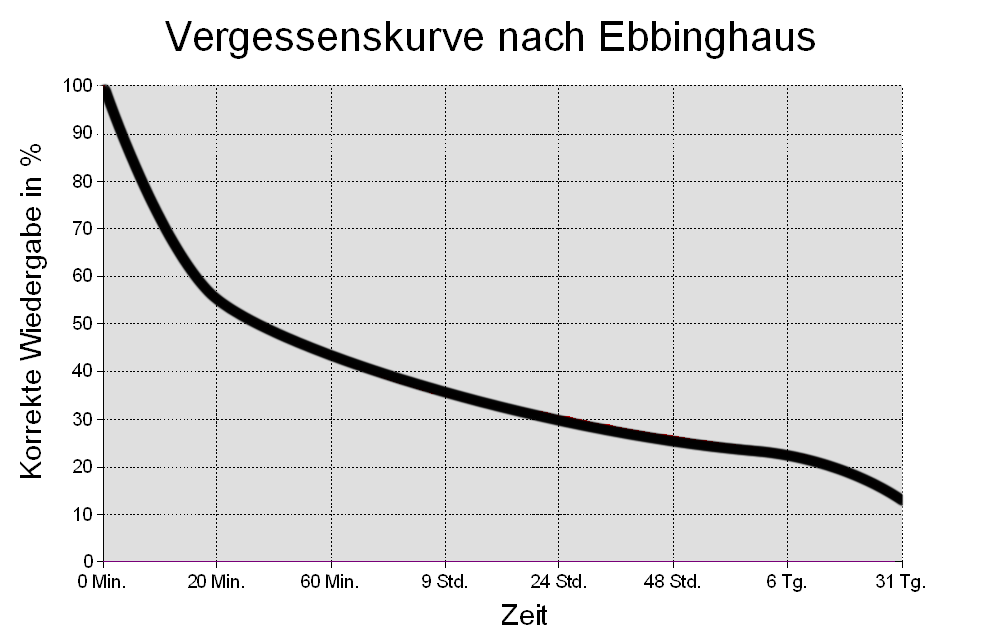
Spaced Repetition intervenes precisely here. Instead of repeating information randomly, it presents it to you at strategically increasing intervals. The trick is to repeat a piece of information just when you are about to forget it. Each time you successfully recall it at this critical moment, you send a strong signal to your brain: "This information is important!" The result: the neural connection is strengthened, the forgetting curve flattens dramatically, and the knowledge gradually moves from the fleeting short-term memory into the safe haven of your long-term memory.
The Power of Active Recall
The second crucial factor is active recall. Passive learning, such as re-reading notes or watching an educational video, often only creates an "illusion of competence." You recognize the information and nod, but that doesn't mean you could reproduce it independently. Real learning happens when you force your brain to retrieve information from its depths without assistance.
This is exactly what happens when you read the front of a flashcard and try to formulate the answer before you flip it over. This act of remembering is the actual training for your memory. Spaced Repetition is essentially a perfectly organized system for continuous active recall.
Implementation in Practice: Analog vs. Digital
You don't have to be a tech guru to start with Spaced Repetition. The method can be implemented with simple, physical flashcards as well as with highly developed software. Both approaches have their advantages and disadvantages.
The Classic: The Leitner System with Physical Flashcards
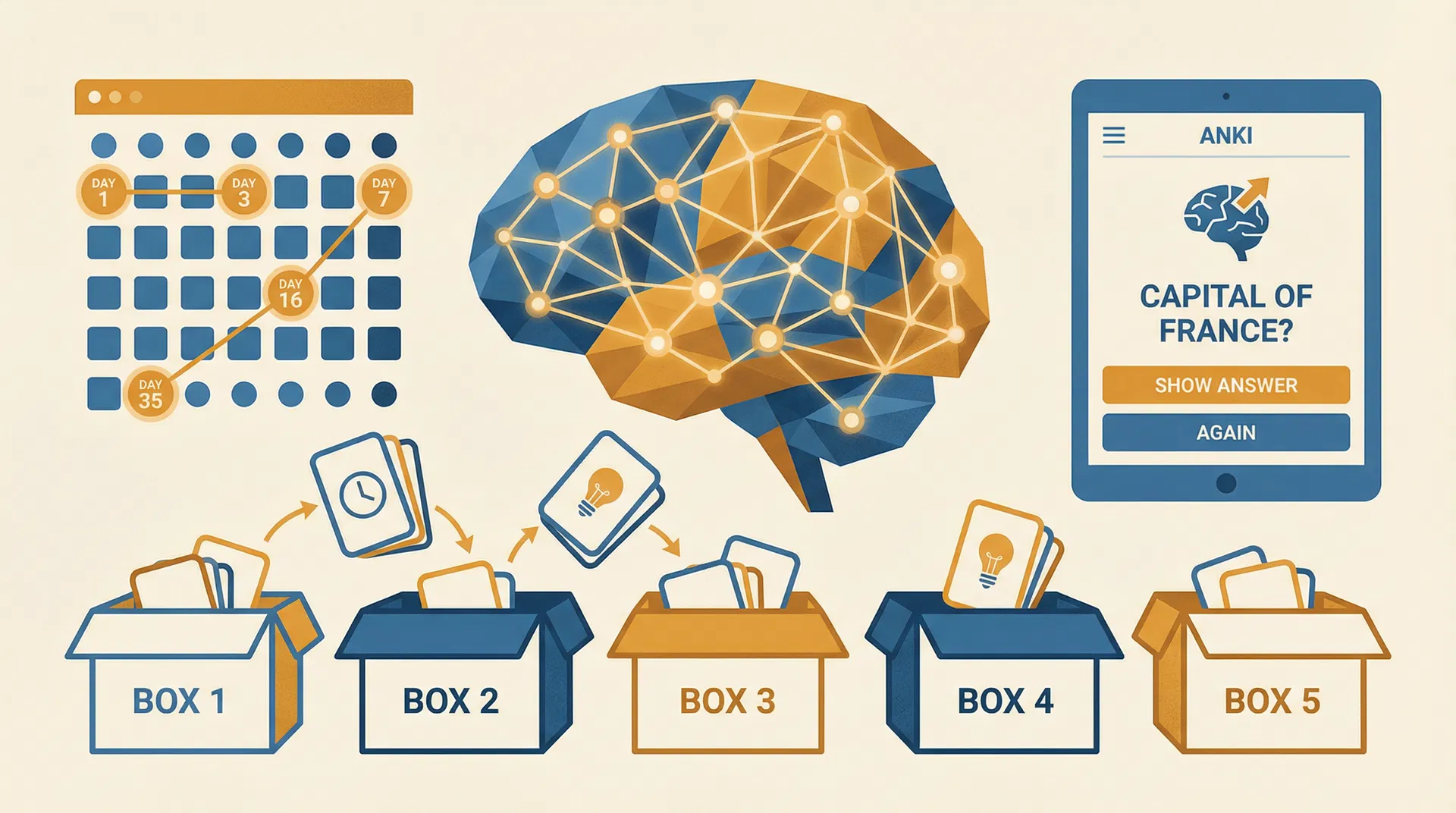
The publicist Sebastian Leitner created a simple but brilliant system in the 1970s that only requires a card box with five compartments and a stack of flashcards.
How the Leitner System works in detail:
- Creation: Write a single, precise question on each card and the equally precise answer on the back. All new cards start in compartment 1.
- Learning (Day 1): Process all cards in compartment 1.
- Answered correctly? The card moves up to compartment 2.
- Answered incorrectly? The card remains in compartment 1.
- Repetition: The trick lies in the different repetition rhythms of the compartments.
| Compartment | Repetition Rhythm (Example) | Status of Knowledge |
|---|---|---|
| 1 | Daily | New & difficult knowledge |
| 2 | Every 2-3 days | Recently learned knowledge |
| 3 | Every week | Consolidated knowledge |
| 4 | Every 2-4 weeks | Well-mastered knowledge |
| 5 | Every 1-3 months | Long-term knowledge (until the exam) |
If you answer a card from one of the higher compartments (e.g., compartment 4) incorrectly, the rule is unforgiving: it falls completely back into compartment 1. This ensures that you immediately and intensively address knowledge gaps instead of ignoring them. You automatically focus your valuable study time on the most difficult content.
The Digital Revolution: Spaced Repetition with Apps like Anki
With hundreds or thousands of facts for the master craftsman exam, manually sorting flashcards can be tedious. This is where digital Spaced Repetition Systems (SRS) shine. By far the most well-known, flexible, and powerful software is Anki.
Anki is a free, open-source program that automates the Spaced Repetition algorithm for you. You create digital flashcards (called "Notes") that can contain text, images, audio, videos, and complex scientific formulas (via LaTeX). After each card, you rate yourself on how easily you recalled the answer (e.g., "Again," "Hard," "Good," "Easy"). Based on this rating, Anki calculates the exact optimal time for the next repetition – be it in 10 minutes, 10 days, or 10 months.
Comparison: Analog (Leitner) vs. Digital (Anki)
| Criterion | Leitner System (Analog) | Anki (Digital) |
|---|---|---|
| Flexibility | Location-bound, requires space | Learn anywhere (PC, smartphone, tablet) |
| Automation | Manual sorting required | Fully automatic algorithm |
| Media | Text and simple drawings | Text, images, audio, video, formulas |
| Creation | Handwritten (can enhance learning effect) | Typing, copying & pasting, import |
| Cost | Low (cards, box) | Free (except iOS app) |
| Entry Barrier | Very low | Medium (requires getting used to software) |
Practical Tips for Aspiring Master Craftsmen and Business Administrators
The method is only as good as the content you feed it. Here are crucial tips to get the most out of Spaced Repetition for your IHK exam.
How to create masterful flashcards:
- Atomic Knowledge: Stick to the rule "one piece of information per card." Instead of "Explain the marketing mix" (too complex), create four individual cards: "What are the 4 Ps in the marketing mix?", "Define 'Product' in the marketing mix?", etc.
- Understand Before Memorizing: Only create a card when you truly understand the concept behind it. The card serves to anchor the knowledge, not for initial learning.
- Formulate as a Question: Force your brain to think. Instead of "The 4 Ps are Product, Price, Place, Promotion," ask: "Which instruments belong to the marketing mix?"
- Use Images: A picture is worth a thousand words. Include diagrams, graphics, or even photos of machine parts in your digital cards. For an aspiring industrial master craftsman, an image of a CNC machine with the question "What safety regulations apply to this component?" can be invaluable.
- Be Honest with Yourself: Self-assessment in Anki is crucial. If you only guessed an answer, be honest and click "Hard" or "Again." Cheating only deceives yourself and undermines the algorithm.
Common mistakes to avoid:
- Procrastinating Reviews: Don't skip a day. Once repetitions pile up, it becomes overwhelming. Daily routine is key.
- Too Complex Cards: If you find yourself answering a card incorrectly repeatedly, it's probably too complicated or unclearly formulated. Break it down into several simpler cards.
- Only Using Pre-made Decks: It's tempting to download pre-made card decks. However, the greatest learning effect comes from creating your own cards, as this forces you to engage intensively with the material. Use pre-made decks as inspiration, but not as a substitute for your own work.
FAQ - Your Questions, Our Answers
How much time should I plan daily for Spaced Repetition?
The beauty of the method is its efficiency. Often, 20-30 minutes of
Tags:
Read more
Other articles that might interest you

Lerngruppen für die Meisterprüfung: So findest und organisierst du die perfekte Gruppe
Der Weg zum Meistertitel ist anspruchsvoll. Eine Lerngruppe kann der Schlüssel zum Erfolg sein. Wir zeigen dir, wie du die perfekte Gruppe findest und organisierst.
Read more
Digitales Lernen vs. Präsenzkurs: Was ist besser für die Meisterprüfung?
Digitales Lernen oder Präsenzkurs für die Meisterprüfung? Wir vergleichen Kosten, Flexibilität und Erfolgschancen, damit Sie die beste Entscheidung treffen.
Read more
Prüfungsangst überwinden: 4 mentale Strategien für die Meisterprüfung
Prüfungsangst vor der Meisterprüfung? Entdecken Sie 4 praxiserprobte mentale Strategien von Atemtechniken bis Zeitmanagement, um die Prüfung souverän zu meistern.
Read more