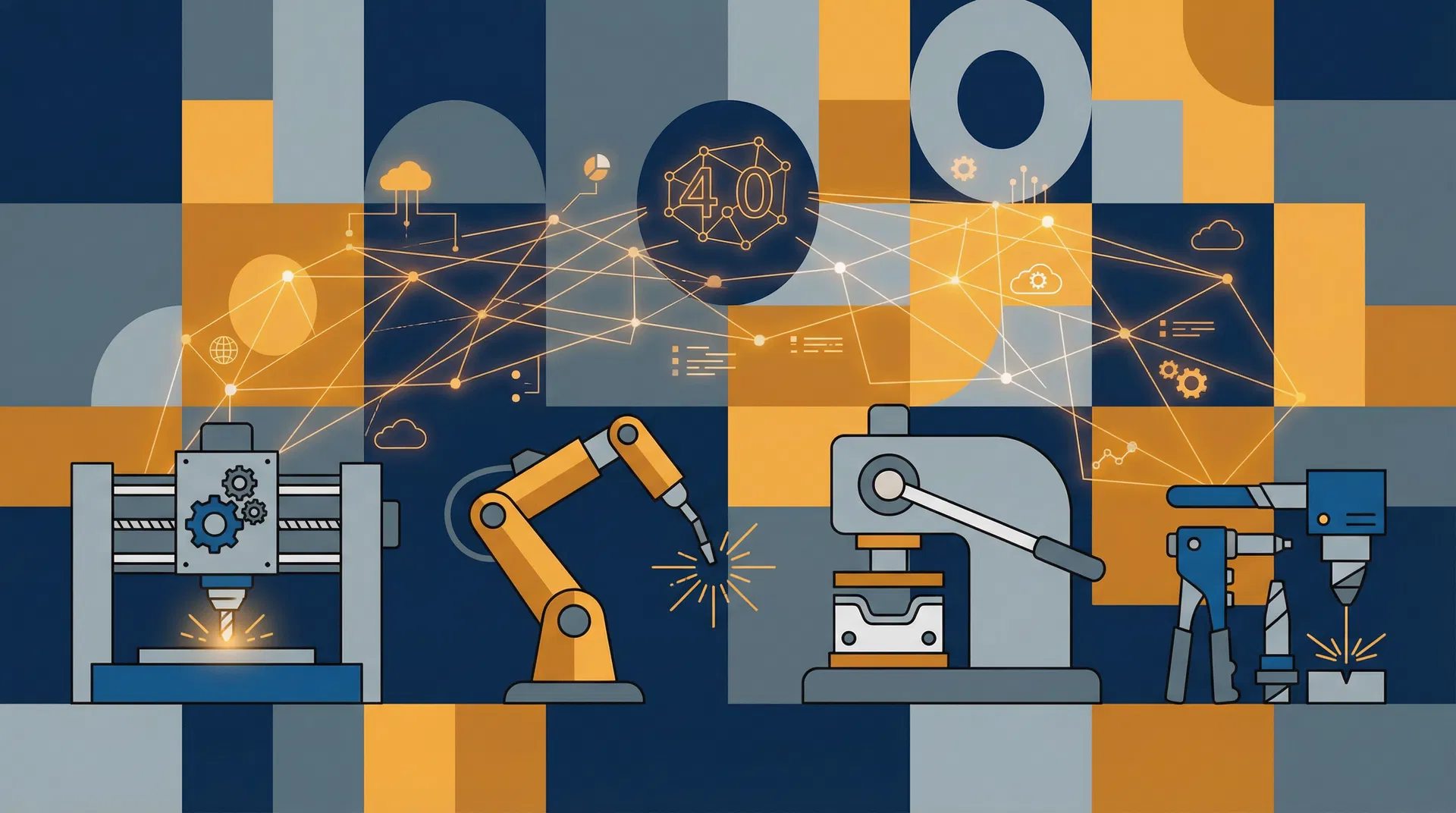
Imagine standing in a modern production hall. The smell of metal and oil hangs in the air, the rhythmic hum of machines fills the space. Here, complex components are created from raw materials, later to be installed in cars, airplanes, or wind turbines. This fascinating world of transformation is the heart of manufacturing technology – and a central building block of knowledge for every aspiring industrial master craftsman in metal. But what exactly lies behind this term, and why is it so crucial for your career? Join us on a journey through the most important manufacturing processes and discover how you can lay the foundation for your success with the right knowledge.
Manufacturing technology is far more than just operating machines. It is the art and science of giving workpieces a specific geometric shape while deliberately altering their material properties. As a future leader, a deep understanding of these processes is essential. You need to know not only how something is manufactured, but also why a particular process is chosen, what economic aspects play a role, and how quality is ensured. This knowledge enables you to optimize production processes, reduce costs, and develop innovative solutions – key competencies that are more in demand than ever in today's job market. On meister.jetzt [blocked], you will find comprehensive learning materials that specifically prepare you for these challenges.
The Six Main Groups of Manufacturing Processes according to DIN 8580: An Overview
To organize and clarify the diversity of manufacturing technology, the German Institute for Standardization (DIN) has established a systematic classification in standard 8580. This division into six main groups is the foundation for understanding all manufacturing processes. It helps you logically categorize the processes and recognize the connections between them. Let's take a closer look at these six pillars of manufacturing technology.
| Main Group | Description | Typical Processes |
|---|---|---|
| 1. Primary Forming | Creating a solid body from formless material (e.g., liquid, powdery). | Casting, Sintering, 3D Printing |
| 2. Forming | Deliberate shaping of a solid body while maintaining its mass. | Rolling, Forging, Deep Drawing |
| 3. Machining | Changing the shape by locally breaking cohesion. | Turning, Milling, Cutting |
| 4. Joining | Permanently connecting two or more workpieces. | Welding, Brazing, Bolting |
| 5. Coating | Applying a firmly adhering layer to a workpiece. | Painting, Electroplating, Hot-dip Galvanizing |
| 6. Changing Material Properties | Deliberate alteration of the material's microstructure properties. | Hardening, Annealing, Tempering |
1. Primary Forming: From Nothing to Form
Primary forming is the creative act in manufacturing technology. This is where the first solid body is created, so to speak, the "birth" of a component. The starting point is formless material – be it a liquid metal melt, a fine powder, or plastic granules. Through various processes, this material is given a defined geometric shape.
Practical Example of Casting: Think of the production of an engine block for a car. Liquid aluminum or cast iron is poured into a complex mold at high temperatures. After solidification and cooling, we have a component that already possesses the basic structure of the future engine block. This process enables the economical production of very complex geometries in high quantities. The challenge here lies in controlling the material's shrinkage behavior and avoiding air inclusions. A practice exam [blocked] on meister.jetzt can help you test your knowledge on this and other topics.
2. Forming: Reshaping Existing Material
In forming, an already solid body is changed in its shape without adding or removing material. The mass and material cohesion are maintained. One can imagine it like kneading a lump of dough, but with metal. These processes are of enormous economic importance as they enable high material utilization and excellent mechanical properties of the end product.
Practical Example of Forging: A classic example is the production of crankshafts. A glowing steel blank is brought into the desired shape by targeted blows from a giant hammer or by the pressure of a press. Through this process, known as bulk forming, the internal structure of the steel is densified and aligned (grain flow). The result is a component of extreme strength and toughness that withstands the high stresses in the engine. Precise temperature control and force dosage are crucial parameters for quality here.
3. Machining: Precision through Material Removal
Machining includes all processes where material is removed from a blank in the form of chips or by other means to create the desired shape or surface. This is about maximum precision. While primary forming and forming create the rough shape, machining provides the fine details, precise dimensions, and smooth surfaces.
Practical Example of Milling: Imagine the production of a gear. A cylindrical blank is clamped into a milling machine. A rotating, multi-edged tool (the milling cutter) moves along a precisely programmed path and removes material chip by chip until the precise tooth shape is created. Modern CNC-controlled milling machines can produce complex three-dimensional contours with micron-level accuracy. Choosing the right cutting speed, feed rate, and tool is the key to success here. Find out about our prices [blocked] and start your further education.
4. Joining: Connecting Individual Parts to a Whole
Rarely does a complex product consist of only a single part. Usually, several individual components must be permanently and securely connected. This is precisely the task of joining. The processes range from traditional methods like bolting to high-tech processes like laser welding.
Practical Example of Welding: In car body construction, countless sheet metal parts are joined to form a stable and safe passenger cell. Robot arms move welding guns with high speed and precision from point to point, connecting the sheets through resistance spot welding. In other places, where particularly strong and dense seams are required, gas-shielded welding (e.g., MAG welding) is used. The challenge is to create a strong connection without unduly altering the material due to the introduced heat (distortion). A deep understanding of the various welding processes and their applications is essential for industrial master craftsmen.
5. Coating: Refining and Protecting Surfaces
Coating serves to apply a firmly adhering layer of another material to the surface of a workpiece. The reasons for this are diverse: protection against corrosion (rust), improvement of wear resistance, alteration of electrical conductivity, or simply a more attractive appearance. The applied material can be gaseous, liquid, or solid.
Practical Example of Hot-dip Galvanizing: To permanently protect a steel guardrail on the highway from wind and weather, it is hot-dip galvanized. The cleaned steel structure is immersed in a bath of approximately 450 °C hot, liquid zinc. The zinc forms a solid, resistant alloy layer on the steel, protecting it from corrosion for decades. This process is an excellent example of effective and economical corrosion protection for large components.
6. Changing Material Properties: Optimizing the Material's Interior
In this main group, it is not the shape but the "interior" – i.e., the microstructure – of the material that is deliberately changed. This is usually done through thermal, chemical, or mechanical treatments. The aim is to adapt properties such as hardness, toughness, or strength to the specific requirements of the component.
Practical Example of Hardening: A drill bit must be extremely hard at its cutting edge to machine other metals, but at the same time remain tough in its core to avoid breaking. This is achieved through hardening. The drill bit is heated to a high temperature and then cooled very quickly (quenched), for example, in water or oil. This changes the crystal structure of the steel on the surface, making it very hard. A subsequent slight reheating (tempering) removes its extreme brittleness and makes it tougher. This process is a prime example of how customized component properties can be created through targeted heat treatment.
From Theory to Practice: Manufacturing Technology in the Digital Age
The six main groups of manufacturing processes form the classic foundation. But modern production is no longer conceivable without digitalization. Two terms are of central importance here: CNC technology and Industry 4.0.
CNC Technology: The Backbone of Modern Manufacturing
CNC stands for "Computerized Numerical Control" and means that machine tools are no longer operated manually but by a computer. The operator writes a program that precisely dictates to the machine which movements it has to perform. This enables an enormous increase in precision, repeatability, and the complexity of the parts that can be manufactured.
Imagine having to manually mill the complex shape of a turbine wheel – an almost impossible task. A CNC machine does this with ease and consistently high quality, 24 hours a day. For you as an industrial master craftsman, this means: you no longer have to write programs yourself down to the last detail, but you must understand how they work, be able to read and optimize programs, and know how to use the machines efficiently. Registration [blocked] at meister.jetzt is the first step to acquiring this knowledge.
Industry 4.0 and the Smart Factory: The Future Has Already Begun
Industry 4.0 describes the fourth industrial revolution, characterized by the intelligent networking of machines, products, and people. In the "Smart Factory," workpieces communicate with machines and control their own production process. Sensors continuously collect data on the condition of the systems and enable predictive maintenance before a failure occurs.
A concrete example: An intelligent workpiece carries an RFID chip with all information about its processing. At each station, it registers, the machine reads the data, and immediately knows what to do. At the same time, the machine reports its own status to a central system. If a tool threatens to wear out,
Tags:
Read more
Other articles that might interest you
Personalführung und Personalentwicklung: Der HQ-Prüfungsguide für Industriemeister
Dieser umfassende Guide bereitet angehende Industriemeister optimal auf die HQ-Prüfung in Personalführung und Personalentwicklung vor. Erfahre alles über die zentralen Themen und erhalte wertvolle Tipps.
Read more
Produktionsplanung und -steuerung (PPS): Alles für die HQ-Prüfung
Erfahre alles über die Produktionsplanung und -steuerung (PPS) für deine HQ-Prüfung. Von den Grundlagen über PPS-Systeme bis hin zu Lean Production – hier findest du alles, was du wissen musst.
Read more
Qualitätsmanagement für Industriemeister: ISO 9001, TQM & KVP einfach erklärt
Meistern Sie das Qualitätsmanagement! Unser Guide für Industriemeister erklärt ISO 9001, TQM, KVP und die wichtigsten Werkzeuge wie PDCA-Zyklus und Six Sigma. Praxisnah und prüfungsrelevant.
Read more