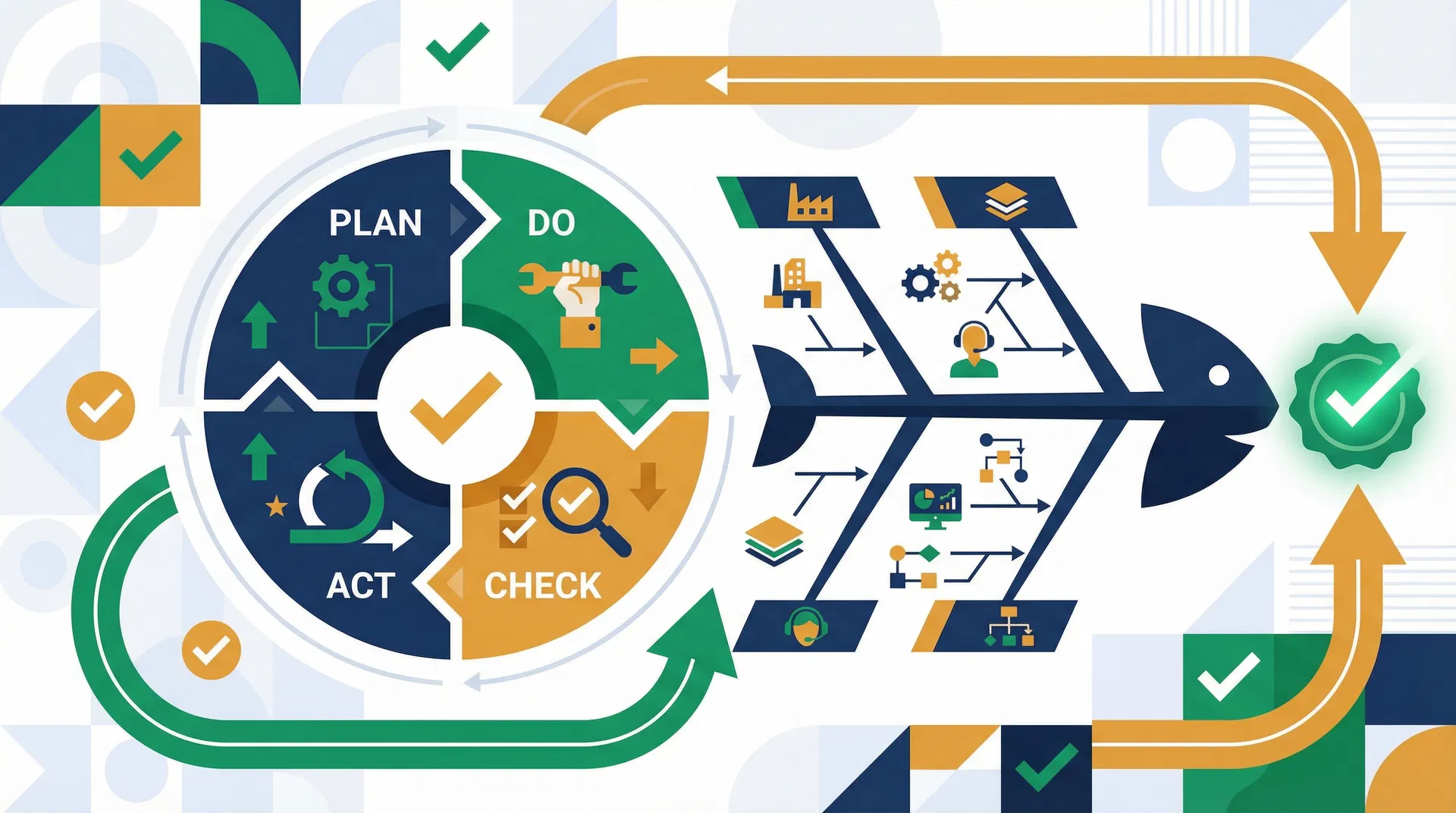
For aspiring industrial foremen, quality management is not just an examination subject, but a crucial factor for professional success. In modern industry, characterized by high competitive intensity and increasing customer demands, effective quality management forms the backbone for efficient processes and high-quality products. But what exactly lies behind terms like ISO 9001, Total Quality Management (TQM), and Continuous Improvement Process (CIP)? And how can tools like the PDCA cycle, the Ishikawa diagram, or the Pareto principle be applied in practice? This article provides a comprehensive insight into the world of quality management and shows why these competencies are indispensable for industrial foremen.
What is Quality Management and Why is it Crucial for Industrial Foremen?
Quality management (QM) encompasses all organizational measures that serve to improve process quality, services, and thus products and services of all kinds. For an industrial foreman, this specifically means taking responsibility for ensuring and continuously improving quality in their area of responsibility. It's about not just finding and fixing errors, but designing processes in such a way that errors are avoided from the outset.
The role of the industrial foreman has changed significantly in recent years. Away from being a mere supervisor, towards being a manager and coach of their department. In this function, they are the central interface between company management and employees in production. They are responsible for implementing the company's quality specifications in practice and for sensitizing and motivating their employees on the topic of quality. Proactive quality management leads to a reduction in scrap and rework, which in turn lowers costs. At the same time, customer satisfaction increases through reliable and flawless products, which sustainably strengthens the company's competitiveness.
The Three Pillars of Modern Quality Management
Modern quality management rests on three essential pillars that every aspiring industrial foreman should know and understand: the ISO 9001 standard, the philosophy of Total Quality Management (TQM), and the Continuous Improvement Process (CIP).
ISO 9001: The Foundation for QM Systems
ISO 9001 is an internationally recognized standard that defines the minimum requirements for a quality management system (QMS). It is industry-independent and can be applied by any company, regardless of its size. A QMS certified according to ISO 9001 signals to customers and business partners that the company has established and tested processes for quality assurance. For industrial foremen, knowledge of ISO 9001 is crucial, as it provides the framework for designing and monitoring quality processes in their own area of responsibility. The standard defines seven quality management principles, including customer focus, leadership, engagement of people, process approach, improvement, evidence-based decision making, and relationship management. On meister.jetzt [blocked], you will find comprehensive learning materials to help you understand the requirements of ISO 9001 in detail.
Total Quality Management (TQM): A Matter of Corporate Culture
Total Quality Management (TQM) is a comprehensive management philosophy that places quality at the center of all company activities. Unlike ISO 9001, which focuses on establishing processes, TQM aims to create a culture of continuous improvement in which all employees at all levels are involved. The industrial foreman plays a key role in this. They must act as a role model and empower and encourage their employees to actively participate in improving processes and products. A practical example of TQM in a manufacturing company could be the introduction of quality circles, where employees regularly meet to discuss quality problems and develop solutions.
Continuous Improvement Process (CIP): Stagnation is Regression
The Continuous Improvement Process (CIP), also known as Kaizen, is an essential component of TQM and ISO 9001. It describes the constant search for small, incremental improvements in all areas of the company. For the industrial foreman, CIP means never taking the status quo for granted, but always looking for ways to optimize processes, reduce waste, and increase efficiency. This can be done through regular process analyses, employee surveys, or the evaluation of quality data. With our practice exam [blocked], you can test your knowledge of CIP and other important QM topics and prepare optimally for the exam.
Quality Management Tools in Practice
To successfully implement the principles of quality management, the industrial foreman has a variety of tools and methods at their disposal. Knowledge and application of these tools are crucial for systematically analyzing quality problems and developing sustainable solutions.
The PDCA Cycle: The Engine of Improvement
The PDCA cycle, also known as the Deming cycle, is an iterative, four-phase method for controlling and continuously improving processes. It is the heart of CIP and a fundamental tool for every industrial foreman.
| Phase | Description |
|---|---|
| Plan | A problem is identified, analyzed, and an improvement goal is set. An action plan is developed. |
| Do | The planned measures are implemented and tested on a limited scale. |
| Check | The results are measured and compared with the previously defined goals. |
| Act | If successful, the measures are introduced as a new standard. If there are deviations, the cycle is repeated with new insights. |
A practical example: Scratches are increasingly appearing on a component in a production line. The industrial foreman initiates a PDCA cycle. (Plan) The team analyzes the problem and suspects that insufficient padding in the transport containers is the cause. It is planned to test a new type of protective film. (Do) Some containers are equipped with the new film and used for a test batch. (Check) The components from the test containers are inspected. The scratch rate has decreased significantly. (Act) The new protective film is introduced as standard for all transport containers, and the work instruction is adjusted accordingly.
Ishikawa Diagram: Tracing the Causes
The Ishikawa diagram, also known as the fishbone diagram or cause-and-effect diagram, is a tool for systematically identifying problem causes. It helps to structure and visualize the many possible causes of a problem. The main cause categories are often the "7 Ms": Man, Machine, Material, Method, Milieu (Environment), Measurement, and Management. When analyzing a production error, for example, the diagram could show that the cause is not, as initially suspected, a machine problem, but rather inadequate employee training (Man) or faulty raw material (Material).
Pareto Principle (80/20 Rule): Setting Priorities Correctly
The Pareto principle states that in many cases, 80% of the effects are due to 20% of the causes. In quality management, this principle helps to focus efforts on the truly important problems. Instead of trying to tackle all sources of error at once, the industrial foreman uses a Pareto analysis to identify the few but crucial causes responsible for the majority of quality problems. For example, if it is found that 80% of customer complaints are due to two out of ten possible product defects, improvement measures should be focused on these two defects to achieve the greatest impact.
Six Sigma: Quality at the Highest Level
Six Sigma is a data-driven and process-oriented management methodology whose goal is to improve process quality to such an extent that the error rate tends towards zero. The core of Six Sigma is the DMAIC cycle (Define, Measure, Analyze, Improve, Control). For an industrial foreman, it is important to understand the basic principles of Six Sigma, as this methodology is standard in many large companies. It is about making processes measurable, making data-driven decisions, and establishing a culture of zero-defect tolerance.
Quality Management as a Success Factor for Your Career
Mastering the principles and tools of quality management is far more than just an exam requirement for industrial foremen. It is a decisive lever for career advancement. Companies are looking for leaders who not only manage the status quo but actively contribute to value creation. By optimizing processes, increasing product quality, and reducing costs, you demonstrate your management competence and recommend yourself for higher tasks. The ability to translate theoretical knowledge into practice and inspire a team for the common goal of quality distinguishes an excellent industrial foreman. Start your journey today and register [blocked] at meister.jetzt to unleash your full potential.
Ready for the Next Step? Test Your Knowledge!
Do you feel inspired and want to put your knowledge of quality management to the test? Then now is the perfect time to get started! At meister.jetzt, you can test our entire learning platform for 3 days free of charge. Use our interactive learning materials, practical exercises, and authentic practice exams to prepare optimally for your master craftsman exam. Convince yourself of our innovative learning concept. Find out about our fair prices [blocked] and start a successful future as an industrial foreman today!
Frequently Asked Questions (FAQ) about Quality Management
1. Is ISO 9001 certification mandatory for every company?
No, ISO 9001 certification is generally voluntary. However, it is required by many customers, especially in the B2B sector, as proof of a functioning quality management system and is therefore often an important competitive advantage.
2. What is the difference between CIP and Kaizen?
Basically, both terms describe the same philosophy of continuous, incremental improvement. "Kaizen" is the Japanese original term, while "CIP" is the German translation. In practice, both terms are often used synonymously.
3. Do I have to be a Six Sigma "Black Belt" as an industrial foreman?
No, that is generally not expected. However, an industrial foreman should understand the basic principles of Six Sigma and the DMAIC cycle in order to be able to work effectively and support improvement projects in companies that use this method.
4. How do I best start with CIP in my department?
A good starting point is the introduction of a simple suggestion system where employees can submit
Tags:
Read more
Other articles that might interest you
Personalführung und Personalentwicklung: Der HQ-Prüfungsguide für Industriemeister
Dieser umfassende Guide bereitet angehende Industriemeister optimal auf die HQ-Prüfung in Personalführung und Personalentwicklung vor. Erfahre alles über die zentralen Themen und erhalte wertvolle Tipps.
Read more
Produktionsplanung und -steuerung (PPS): Alles für die HQ-Prüfung
Erfahre alles über die Produktionsplanung und -steuerung (PPS) für deine HQ-Prüfung. Von den Grundlagen über PPS-Systeme bis hin zu Lean Production – hier findest du alles, was du wissen musst.
Read more
Fertigungstechnik für Industriemeister Metall: Der große Überblick 2025
Entdecken Sie die Welt der Fertigungstechnik für Industriemeister Metall! Von Urformen bis Industrie 4.0 – dieser umfassende Überblick bereitet Sie optimal auf die Prüfung vor.
Read more