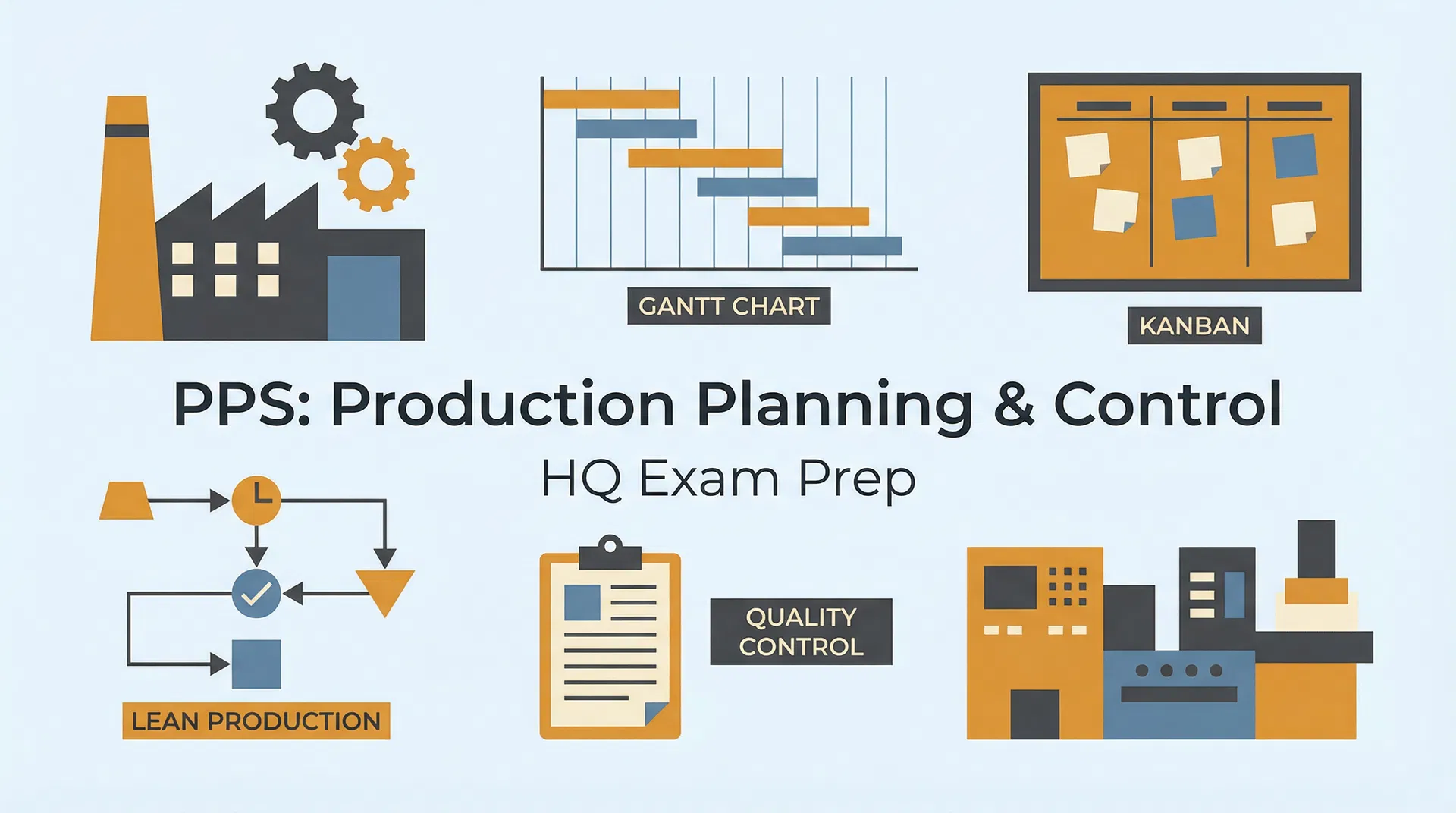
Production Planning and Control (PPC): Everything for the HQ Exam
Introduction
Imagine you are a newly qualified industrial foreman working in a modern manufacturing company. Your task is to ensure that production runs smoothly, machines are optimally utilized, materials are in the right place at the right time, and customers receive their orders punctually. This is precisely where Production Planning and Control, or PPC for short, comes into play. It is the brain of every modern manufacturing operation and an absolutely central topic for your Action-Specific Qualification (HQ) in the industrial foreman exam.
But don't worry, the topic is less dry than it might seem at first glance. In this article, we will explore the world of PPC together. We will clarify what the term means, what tasks PPC encompasses, and why it is so crucial for you as a prospective foreman. We will also show you how modern approaches like Lean Production are revolutionizing PPC and how you can best prepare for exam questions on this topic. In the end, you will see: with the right understanding, PPC is a powerful tool that will bring you decisive advantages not only in the exam but also in your future career as a leader.
What is Production Planning and Control (PPC)?
Production Planning and Control is, simply put, the entire process that ensures a company produces its products efficiently, on time, and in the desired quality. It includes all planning and control measures necessary to organize production from order receipt to delivery. The Gabler Wirtschaftslexikon defines PPC as the systematically prepared determination of the temporal and spatial sequence of actions for the execution of production orders.
PPC pursues several goals simultaneously, which often influence each other:
- High delivery reliability: Meeting delivery dates is crucial for customer satisfaction.
- Short lead times: The faster a product moves through the manufacturing process, the lower the costs and the more flexibly the company can react to changes.
- Low inventory levels: High stocks of raw materials or finished products tie up capital and incur storage costs.
- High capacity utilization: Machines and employees should be used as evenly as possible and without idle times.
In today's era, characterized by global competition and increasing customer demands, functional PPC is vital for companies. It enables them to master complex production processes, reduce costs, and react quickly to new market requirements.
The Core Tasks of PPC: An Overview
The tasks of PPC can be broadly divided into three areas: planning, control, and monitoring. These tasks build logically upon each other and are closely intertwined.
| Task Area | Core Question | Tasks |
|---|---|---|
| Production Planning | What, how much, when, and with what should be produced? | Production program planning, quantity planning, scheduling and capacity planning |
| Production Control | How is the plan put into action? | Order initiation, order release |
| Production Monitoring | Is everything going according to plan? | Monitoring production progress, quality assurance, performance analysis |
Production Planning: Laying the Foundation
The planning phase is the strategic component of PPC. This is where the course for the entire production process is set.
1. Production Program Planning
The first question is: What and how much should be produced in a certain period? The production program defines the type and quantity of end products to be manufactured. This decision is based on the current order backlog, sales forecasts, and available capacities.
2. Quantity Planning (Material Requirements Planning)
Once the production program is established, the material requirements must be determined. Based on the bills of materials for the end products, it is calculated which raw materials, components, and semi-finished products are needed in what quantities. The goal is to provide the right material in the right quantity at the right time – not too early to avoid storage costs, and not too late to prevent production stoppages.
3. Scheduling and Capacity Planning
Now it's time for detailed temporal and spatial planning. When should which order be processed on which machine? Scheduling defines the start and end dates for each operation. Capacity planning ensures that the required capacities (machines, personnel) are actually available. Bottlenecks must be identified and compensated for by measures such as overtime, additional shifts, or outsourcing orders to external service providers.
Production Control: Bringing the Plan to Life
In the control phase, the orders created in planning are released and "fed" into production.
Order Initiation and Release
Order release is the starting signal for production. Production orders are forwarded to the respective workstations, and employees receive all necessary information and documents (e.g., drawings, work plans). Control ensures that orders are processed in the planned sequence and that material is available on time.
Production Monitoring: Staying on Course
Monitoring supervises the ongoing production process and intervenes corrective actions in case of deviations from the plan. It is the control loop that ensures the goals of PPC are achieved. This includes monitoring production progress, recording actual data (e.g., quantities produced, scrap, machine run times), and continuous comparison of target and actual values. In the event of disruptions or plan deviations, countermeasures must be initiated as quickly as possible.
PPC Systems: The Digital Heart of Manufacturing
In practice, the complex tasks of PPC are now supported by powerful IT systems, known as PPC systems. These are often part of a more comprehensive Enterprise Resource Planning (ERP) system, which also integrates other business areas such as finance, human resources, and sales.
A PPC system is a software solution that centrally manages all production data and automates planning, control, and monitoring processes. It helps to handle the enormous amounts of data and apply complex planning algorithms to create optimal production plans.
| Concept | Focus | Key Features |
|---|---|---|
| MRP (Material Requirements Planning) | Material requirements planning | Bill of material explosion, demand calculation |
| MRP II (Manufacturing Resource Planning) | Total resource planning | Integration of capacity planning, financial planning |
| ERP (Enterprise Resource Planning) | Enterprise-wide planning | Integration of all business areas (PPC, finance, HR, etc.) |
The advantages of a modern PPC system are obvious: it creates transparency across the entire supply chain, enables faster and more precise planning, reduces manual effort, and provides the data basis for continuous improvement processes.
Lean Production and PPC: A Strong Duo
In recent decades, the philosophy of Lean Production has revolutionized the manufacturing world. The Lean concept, originally developed by Toyota, aims to eliminate all types of waste (Japanese: "Muda") in the production process and create a continuous value stream to the customer.
At first glance, the centralized, plan-driven world of classic PPC and the decentralized, consumption-driven world of Lean Production seem contradictory. However, in modern manufacturing, both concepts are increasingly converging. "Lean" PPC attempts to integrate the principles of Lean Production into planning and control.
A central element here is the shift from "push" to "pull" control. In classic push control, orders are "pushed" into production based on forecasts. In pull control, however, production is "pulled" by actual consumption at the downstream workstation or by the customer order. Well-known methods for this include Kanban and the Just-in-Time (JIT) principle.
| Aspect | Classic PPC (Push) | Lean PPC (Pull) |
|---|---|---|
| Trigger | Sales forecast, plan | Actual consumption, customer order |
| Inventories | High safety stocks | Minimal, defined buffer stocks |
| Control | Centralized planning and control | Decentralized control loops (e.g., Kanban) |
| Flexibility | Rather sluggish | Highly flexible, quick reaction |
The integration of Lean methods makes PPC more flexible, drastically reduces inventories and lead times, and promotes employee responsibility. It's not about eliminating planning, but about making it smarter and more agile. Rough planning (e.g., the production program) remains central, but detailed control at the base is decentralized and made flexible.
Exam Relevance: What You Need to Know About PPC for the HQ Exam
In the HQ exam, Production Planning and Control is a key topic in the "Technology" area of action. Examiners want to see that you have understood the connections and are able to apply your knowledge to practical case studies. You don't need to be an IT expert for PPC systems, but you should have a solid grasp of the fundamental concepts, tasks, and goals of PPC.
Typical exam topics include:
- Being able to explain the goals and tasks of PPC.
- Being able to describe the individual phases of production planning (program, quantity, scheduling, and capacity planning) and carry them out using an example.
- Being able to explain the difference between push and pull control.
- Being able to explain Lean Production methods (e.g., Kanban, JIT) in the context of PPC.
- Being able to weigh the advantages and disadvantages of different PPC concepts (e.g., centralized vs. decentralized control).
Study Tip: Always try to connect theory with practice. Play through case studies in your head or with colleagues: "A customer orders 100 units of product X. What are the steps that PPC must now initiate?" The better you can visualize the processes, the easier it will be for you to give the correct answers in the exam.
Conclusion
Production Planning and Control is far more than just a dry theoretical topic for the exam. It is the heart of every successful production and a decisive factor for a company's competitiveness. For you as a prospective industrial foreman, a deep understanding of PPC is essential to competently fulfill your future role as a
Tags:
Read more
Other articles that might interest you
Personalführung und Personalentwicklung: Der HQ-Prüfungsguide für Industriemeister
Dieser umfassende Guide bereitet angehende Industriemeister optimal auf die HQ-Prüfung in Personalführung und Personalentwicklung vor. Erfahre alles über die zentralen Themen und erhalte wertvolle Tipps.
Read more
Qualitätsmanagement für Industriemeister: ISO 9001, TQM & KVP einfach erklärt
Meistern Sie das Qualitätsmanagement! Unser Guide für Industriemeister erklärt ISO 9001, TQM, KVP und die wichtigsten Werkzeuge wie PDCA-Zyklus und Six Sigma. Praxisnah und prüfungsrelevant.
Read more
Fertigungstechnik für Industriemeister Metall: Der große Überblick 2025
Entdecken Sie die Welt der Fertigungstechnik für Industriemeister Metall! Von Urformen bis Industrie 4.0 – dieser umfassende Überblick bereitet Sie optimal auf die Prüfung vor.
Read more